A curated journey · Designed and travelled by Parth
Ten Days in Hong Kong & Macau
Victoria Harbour · The Peak · Lantau · Kowloon · Sai Kung · Cotai · Coloane — two territories, four centuries apart, an hour of open water between them.
Curator's Statement
Hong Kong is the most vertical city on earth and the least understood.
People arrive expecting a shopping mall with a skyline and leave having eaten the best meal of their lives in a place with plastic stools. This itinerary is built around that gap.
Ten days, nine nights, two territories that were European colonies until the late 1990s and are now something else entirely. Six nights in Hong Kong, which is the minimum that lets you get past the postcard — the Peak, the harbour and the Big Buddha are all worth doing, and none of them is why the city is interesting. Three nights in Macau, which most people treat as a day trip and which deserves considerably better: four hundred and forty-two years of Portugal, the world's oldest fusion cuisine, and a gaming industry several times the size of Las Vegas, all on a peninsula you can walk across in forty minutes.
What I have tried to do here is alternate. A morning at the Tian Tan Buddha and an afternoon in a stilt village. A Tang dynasty garden with a housing estate behind it. A speedboat through a hundred-and-forty-million-year-old volcanic coastline, and an evening in a Wan Chai roast-goose shop with a Michelin star and eleven tables. The world's number one cocktail bar, and a tofu factory that has been making bean curd by hand on the same street since the 1960s. Hong Kong does high and low better than any city I know, and an itinerary that only does one of them misses the whole thing.
The markets are deliberate. Hong Kong obliges more completely than almost any city on earth — a tram that runs directly through a live wet market, a street where the entire trade is songbirds in bamboo cages, a hundred-year-old electronics flea market, a street selling nothing but abalone and dried fish maw, and another selling nothing but hand-forged woks. None of these are attractions. They are working commerce, which is exactly what makes them worth your time.
Two honest notes before you read on. The nightly Symphony of Lights over Victoria Harbour is being retired during the second half of 2026, so it may or may not exist when you travel — I have written the harbour evening so that it does not depend on the show. And the black sand at Hac Sa is substantially less black than its name and its photographs suggest, because erosion forced the government to replenish the beach with ordinary sand. Both are still worth your time. Neither is quite what the brochures say, and you should know that before you go rather than after.
Each day below opens with a short narrative of what to do and why, followed by insider notes — the things that are easy to get wrong and expensive to learn the hard way. After that you will find where to eat, including something sweet for every day, and the approximate cost of every ticket and excursion mentioned. Prices are shown in Hong Kong dollars and Macanese patacas and were accurate at the time of writing. Treat every figure as a planning estimate rather than a quotation, and confirm at the point of booking. The best rooms in both cities are small, and several take no reservations at all, which is noted where it applies.
The Route at a Glance
Six nights north of the water, three nights south of it.
Where you sleep
| When | Where | Nights |
|---|---|---|
| Day 1 | Arrival in Hong Kong, Victoria Harbour by night | 1 |
| Days 2–6 | Hong Kong, with a full day on Lantau and a full day in Sai Kung | 5 |
| Days 7–9 | Macau — Cotai, the historic centre, and Coloane | 3 |
| Day 10 | Departure, via the SkyPier ferry to HKIA | — |
There is no car on this itinerary and there should not be. Hong Kong parking is among the most expensive in the world, Macau is small enough to walk, and both territories are served by public transport that puts most of Europe to shame.
How you move
- Within Hong Kong — the MTR, the trams, the Star Ferry and your feet. One Octopus card covers all of it. This is one of the great public transport systems in the world and a taxi is almost never the right answer.
- To Lantau — MTR to Tung Chung, then the Ngong Ping 360 cable car. Twenty-five minutes and one of the best approaches to any monument in Asia.
- To Sai Kung — bus 92 from Diamond Hill MTR, about forty-five minutes, or a taxi. Then a speedboat from the town pier into the Geopark.
- Hong Kong to Macau — TurboJET ferry, about an hour, from Sheung Wan or Tsim Sha Tsui. Immigration in both directions; passports required.
- Within Macau — free casino shuttle buses, which run constantly between the ferry terminals, the border and every major resort, and which you can use whether or not you are staying. Local buses for Coloane.
- Departure — the SkyPier ferry from Macau directly to Hong Kong airport, airside, without entering Hong Kong. See Day 10; this is the single most useful piece of logistics on the trip.
Where You Stay
Two hotels, one per territory, both under USD 400 a night.
Both were chosen for what is within a fifteen-minute walk of the front door rather than for the lobby.
Hotel ICON · Tsim Sha Tsui East, Kowloon — 6 nights
USD 250–330 per night
- Owned and run by Hong Kong Polytechnic University as a teaching hotel, which means unusually attentive service.
- Harbour-view rooms, a rooftop infinity pool, and a vertical garden in the lobby by Patrick Blanc.
- Eight minutes on foot to the Avenue of Stars and the Star Ferry.
Wynn Palace · Cotai, Macau — 3 nights
USD 300–380 per night
- The best rooms on Cotai at this price, and a serious art collection in the public spaces.
- The SkyCab gondola over the Performance Lake departs from the door.
- The Venetian and City of Dreams are both a short walk or a free shuttle away.
If you would rather — Hong Kong
- For the view — Regent Hong Kong on the Tsim Sha Tsui waterfront has the best harbour views in the city from floor-to-ceiling windows, at roughly USD 450–600. Rosewood Hong Kong is the finest hotel in town and prices accordingly.
- For the island — The Murray, a Norman Foster conversion of a 1969 government office block in Admiralty, with a garden and a pool, walkable to the Peak Tram and Central. Around USD 330–420.
- For the markets — Cordis Hong Kong sits directly above Langham Place in Mong Kok, putting every market on Day 4 within ten minutes of the lift. Around USD 200–280 and excellent value.
If you would rather — Macau
- For the architecture — Morpheus at City of Dreams, Zaha Hadid's last completed building, with an exposed exoskeleton and a free-form atrium. Around USD 350–450. The Venetian is the cheapest way to stay on Cotai and every room is a suite.
- For the quiet — Grand Coloane Resort sits directly above Hac Sa beach, forty minutes from the casinos and a different world entirely. Around USD 120–180. Worth considering for the final night if the beach day appeals more than the tables.
- A note on rates — both cities price by demand. Macau spikes hard at weekends and during mainland public holidays; Chinese New Year, Golden Week in early October and Labour Day in early May can double a room rate and fill every restaurant. A midweek arrival in Macau will cost meaningfully less than a Friday one.
What This Trip Costs
Roughly $6,600 for two, done comfortably.
The figures below reflect a comfortable, well-appointed version of this itinerary for two travellers sharing a room. International airfare is not included. Gambling is not included, for reasons that should be obvious.
Estimated budget · Two travellers · 9 nights
| Accommodation — 6 nights in Hong Kong, 3 in Macau, both four-star and above | $2,800 |
| Food and drink — street food, dai pai dongs, two or three serious dinners, something sweet daily | $1,800 |
| Attractions and tickets — Geopark boat, Ngong Ping 360, Peak Tram, M+, House of Dancing Water, all admissions for two | $700 |
| Bars and nightlife — Bar Leone, Coa, Ozone and the rest; Hong Kong cocktails are priced like London | $450 |
| Ferries, Hong Kong to Macau — return crossing for two, plus the SkyPier transfer on departure | $180 |
| Local transport — Octopus cards, MTR, trams, Star Ferry, Macau buses, occasional taxis | $160 |
| Airport transfers — Airport Express both directions, plus hotel shuttles | $90 |
| Shopping, tips, incidentals — including a wok from Shanghai Street and almond cookies from Macau | $450 |
| Total, excluding international flights and any gaming | ≈ $6,600 |
Where the money actually goes: this is a notably cheaper trip than the equivalent ten days in Western Europe, and the reason is food. Hong Kong has more Michelin stars per square kilometre than almost anywhere on earth, and it also has some of the best cheap eating in the world — a bowl of wonton noodles from a shop that has been perfecting them for eighty years costs about five dollars. You can eat superbly here for twenty dollars a day or for four hundred, and the twenty-dollar version is not a compromise. The budget above assumes you do both.
Drinks are the exception. Hong Kong cocktail bars are priced at London and New York levels, and Ozone at the top of the ICC charges for the altitude. Two rounds at a World's 50 Best bar will cost more than dinner did.
LEANER
≈ $4,500
Stay at Cordis in Mong Kok and the Venetian in Macau, skip House of Dancing Water and Ozone, walk the free High Island Geo Trail instead of taking the Geopark boat, and eat entirely at street level and in cha chaan tengs. Nothing else on the sightseeing list changes and the trip loses very little.
ELEVATED
$14,000+
Rosewood Hong Kong and a Fountain View suite at Wynn Palace, dinner at Robuchon au Dôme and Lung King Heen, a private junk charter for the Sai Kung day rather than the shared speedboat (roughly HKD 8,000–15,000 for the boat, skipper included), a helicopter transfer to Macau instead of the ferry (fifteen minutes, roughly USD 600 per person), and a private guide for the Sham Shui Po and Sheung Wan market days.
IF YOU GAMBLE
Set the number first
Macau minimums on Cotai start around HKD 500 to 1,000 a hand at baccarat, which is the game the city runs on. The older peninsula houses have lower minimums and far more character. Treat whatever you bring as the price of the evening rather than an investment.
Costs are estimates in US dollars at prevailing exchange rates and are intended for planning. They are not a quotation, and final pricing depends on travel dates, availability, and how you choose to travel.
Day 1 · Hong Kong
Arrival, and the Harbour After Dark
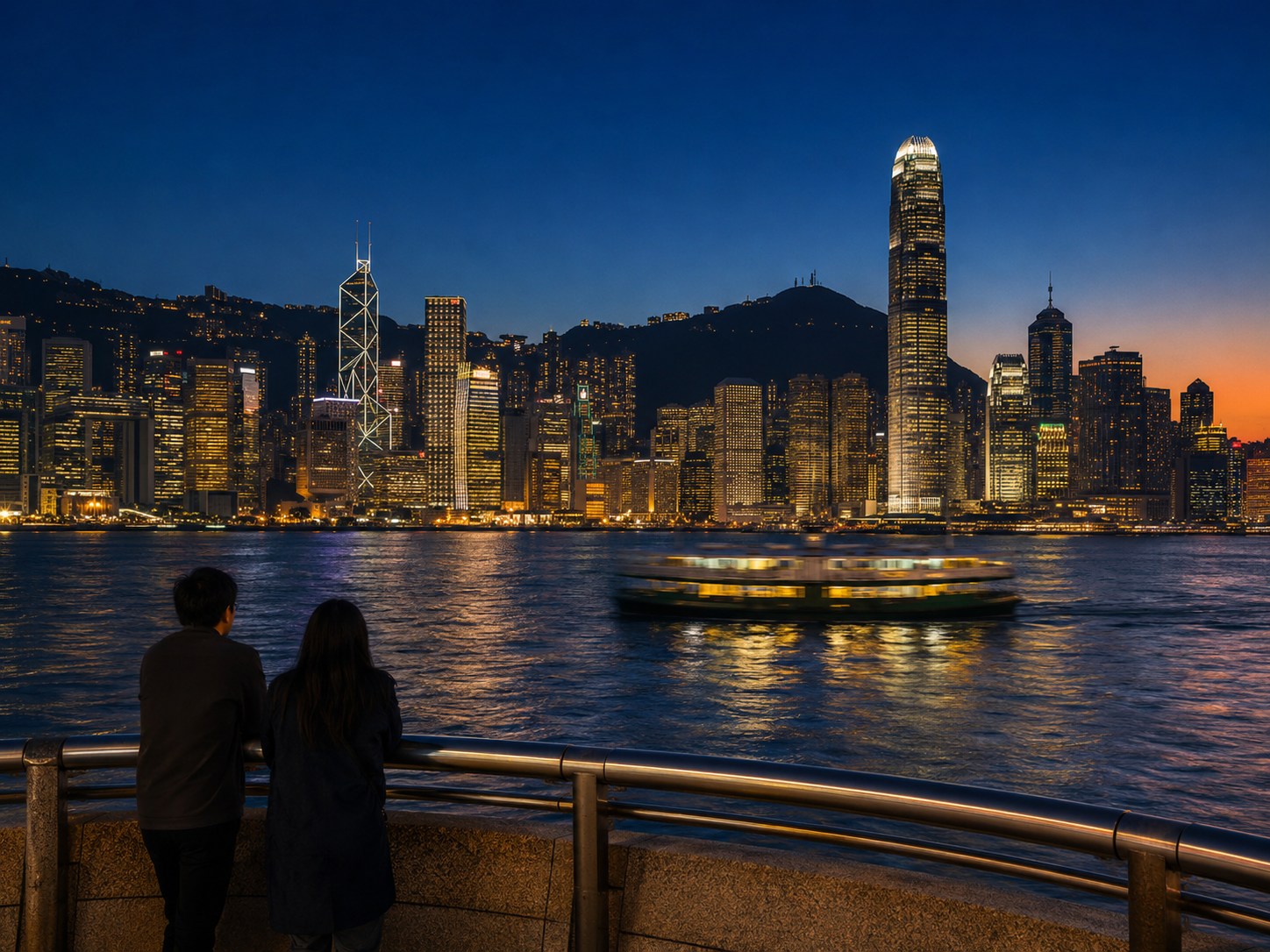
The city introduces itself in one direction only: across the water, after dark. Illustrative image
Hong Kong International is one of the most efficient airports on earth and the Airport Express will have you in Kowloon in twenty-two minutes. Drop the bags, resist the bed, and go straight down to the water — because whatever else Hong Kong is, it is first a harbour, and the single best thing in the city is free and happens every evening at dusk.
Walk the Avenue of Stars, which was rebuilt and reopened in 2019 and is now a proper landscaped promenade rather than the concrete strip it used to be: Bruce Lee in bronze mid-stance, Anita Mui, handprints set into the railing, and behind all of it the entire Hong Kong Island skyline stacked up against the Peak. Keep walking east along the Tsim Sha Tsui promenade as the light goes and the towers come on one by one. Then take the Star Ferry across and back — it costs less than a dollar, it has been running since 1888, and the ten minutes on the lower deck with the wind and the diesel and the skyline sliding past is the best-value experience in Asia. Dinner in Tsim Sha Tsui, early, and sleep.
Insider Notes
- Buy an Octopus card at the airport, or add one to your phone. It pays for the MTR, buses, trams, the Star Ferry, convenience stores and most cha chaan tengs. Hong Kong runs on it, and fumbling for coins on a tram while a queue builds behind you is the mark of someone who has just landed.
- A Symphony of Lights is being retired. The government confirmed in the February 2026 budget that the 22-year-old harbour show ends in the second half of this year, replaced by seasonal light festivals at various locations. It may still be running when you travel and it may not — check the Tourism Commission site before you build an evening around it. Candidly, the skyline itself is the spectacle and the show was always the lesser part of it.
- Take the Star Ferry lower deck, not the upper. It is cheaper, it is closer to the water, and the windows are open. The upper deck is for people who have read a guidebook.
- The Airport Express beats a taxi on time and cost, and has free shuttle buses from Kowloon and Hong Kong stations to most major hotels. Buy a return at the airport; it is meaningfully cheaper than two singles.
- The air conditioning is arctic. Hong Kong is subtropical, and whatever the weather outside, you want a light layer for indoors. Restaurants, malls and the MTR are all kept at a temperature that surprises first-time visitors.
Where to Eat
- Dinner — Spring Deer on Mody Road, a Tsim Sha Tsui institution since the 1950s doing Peking duck carved at the table in a dining room that has not been redecorated in decades. Book, or go early.
- Late — Australia Dairy Company in Jordan for steamed milk pudding and scrambled eggs on toast. The service is famously abrupt, the queue moves fast, and it is one of the most purely Hong Kong experiences available.
- Sweet — An egg tart from Tai Cheong Bakery. Shortcrust rather than puff pastry, still warm, and the reason the last British governor is remembered fondly by at least some people.
Tickets & Costs
| Airport Express, single / return | HKD 115 / 205 |
| Octopus card, with initial stored value | HKD 150 |
| Star Ferry, lower deck, one way | HKD 5 |
| Avenue of Stars and the promenade | Free |
Day 2 · Hong Kong
A Tram Through a Wet Market, and the Peak at Sunset
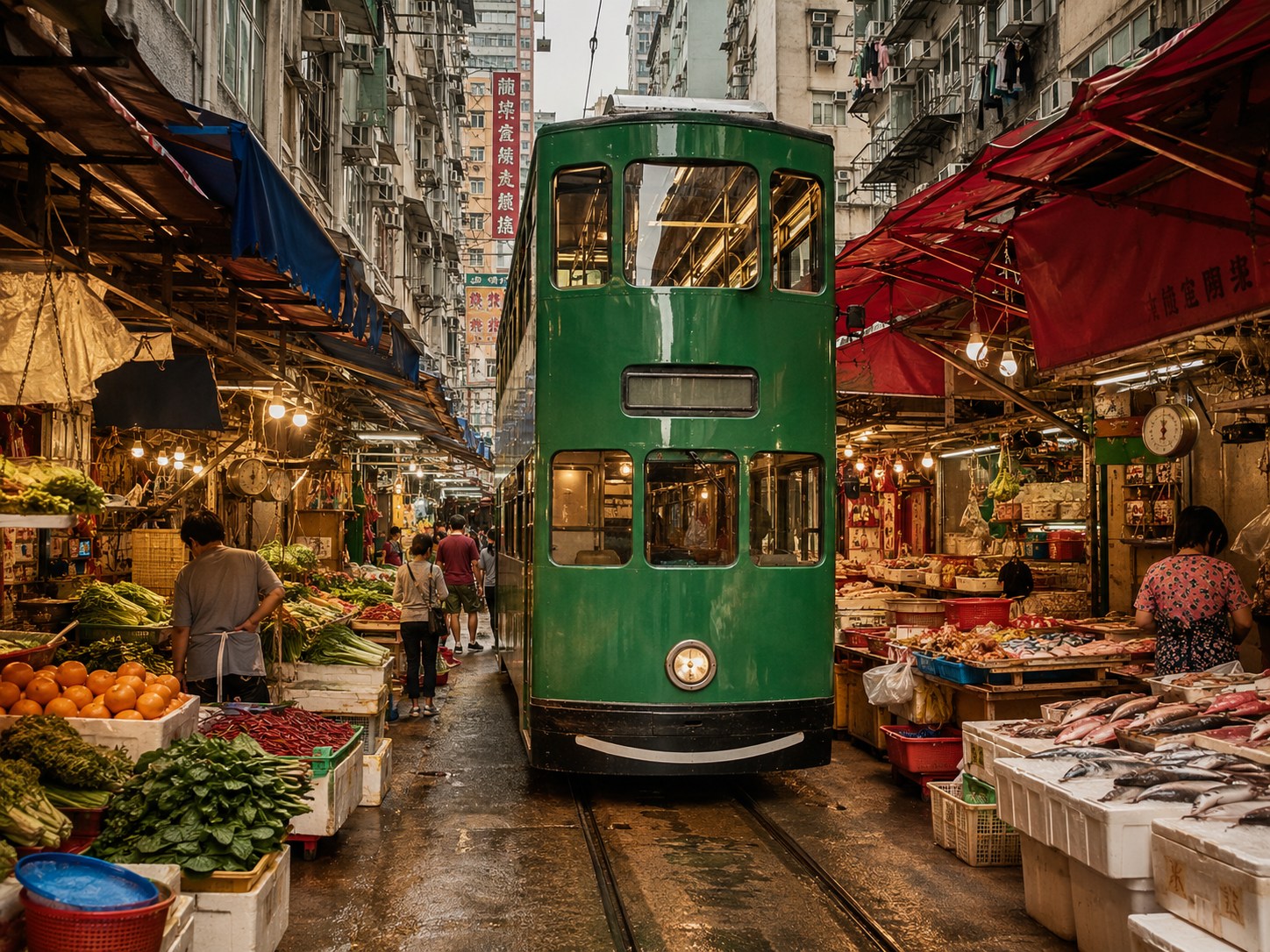
For ninety seconds the market makes room. Then it closes again behind the tram, like water. Illustrative image
Start with the strangest piece of street theatre in Hong Kong. Take the Star Ferry to Central, then board a tram — the double-decker 'ding ding', running since 1904 and still the cheapest ride in the city — and go east to North Point. At Chun Yeung Street the tram does something that exists nowhere else on earth: it runs directly through a live wet market. Awnings retract, stallholders pull back their crates of bok choy and live crabs, the tram grinds past with maybe twenty centimetres of clearance on each side, and the market closes behind it like water. Ride through it once, get off, walk back through on foot, and understand that this is a working market rather than an attraction — buy something, or at least buy your fruit here.
Tram back west and give the middle of the day to Central and Sheung Wan on foot. Ride the Mid-Levels Escalator, the longest outdoor covered escalator system in the world, which runs downhill until ten in the morning and uphill for the rest of the day. Stop at Man Mo Temple on Hollywood Road, where the ceiling is hung with enormous coils of burning incense that take three weeks to smoulder through. Work along Upper Lascar Row — Cat Street — for jade, chops, Mao-era enamelware and a great deal of confident fakery. Then Des Voeux Road West, the Dried Seafood Street, where the shopfronts are stacked to the ceiling with abalone, fish maw, dried scallops and sea cucumber, and the smell is extraordinary and completely unlike anything in a Western city. In the late afternoon, take the Peak Tram up for sunset. Evening in Soho.
Insider Notes
- Book a timed Peak Tram Sky Pass. The tram runs on new sixth-generation cars since 2022 with far greater capacity, but the queue at the Garden Road terminus is still the bottleneck. Aim to be at the top about forty-five minutes before sunset so you get the day view, the golden hour and the lit skyline in one visit.
- Skip Sky Terrace 428 if you would rather not pay. The Peak Galleria roof terrace next door is free and the view is very nearly the same. Better still, walk the Lugard Road circuit — a flat, shaded, one-hour loop around the mountain with the classic postcard view about ten minutes in, and almost nobody on it.
- The tram costs a flat HKD 3 regardless of distance and you pay when you get off, at the front. Board at the back. Sit upstairs at the very front, which is the best seat in Hong Kong public transport.
- Photograph respectfully at Chun Yeung Street. This is where people do their shopping. Wide shots of the tram are fine; close-ups of stallholders' faces without asking are not.
- Man Mo Temple is free and working. The incense smoke is thick enough to sting; step out and back in if it gets much. Do not photograph people mid-prayer.
Where to Eat
- Lunch — Sing Heung Yuen on Mei Lun Street, an open-air dai pai dong under a bamboo awning serving tomato broth noodles with a fried egg and crispy instant noodles. It sounds wrong and it is superb. Cash, plastic stools, closed Sundays.
- Snack — Kau Kee on Gough Street for beef brisket noodles, which people have queued for since the 1930s. Or Yat Lok on Stanley Street for Michelin-starred roast goose over rice, served in about ninety seconds.
- Dinner — The Chairman in Central, named the best restaurant in Asia in 2021, does a flowery crab steamed with aged Shaoxing wine and chicken oil that is worth planning a trip around. Book six to eight weeks ahead. For something less ceremonial, Ho Lee Fook on Elgin Street.
- Sweet — Mammy Pancake, or a bowl of mango sago at Hui Lau Shan.
Tickets & Costs
| Hong Kong tram, any distance | HKD 3 |
| Peak Tram return with Sky Terrace 428 | HKD 148 |
| Peak Tram return only | HKD 88 |
| Peak Galleria roof terrace / Lugard Road | Free |
| Man Mo Temple | Free |
Day 3 · Lantau
The Big Buddha, and a Village Built on Stilts
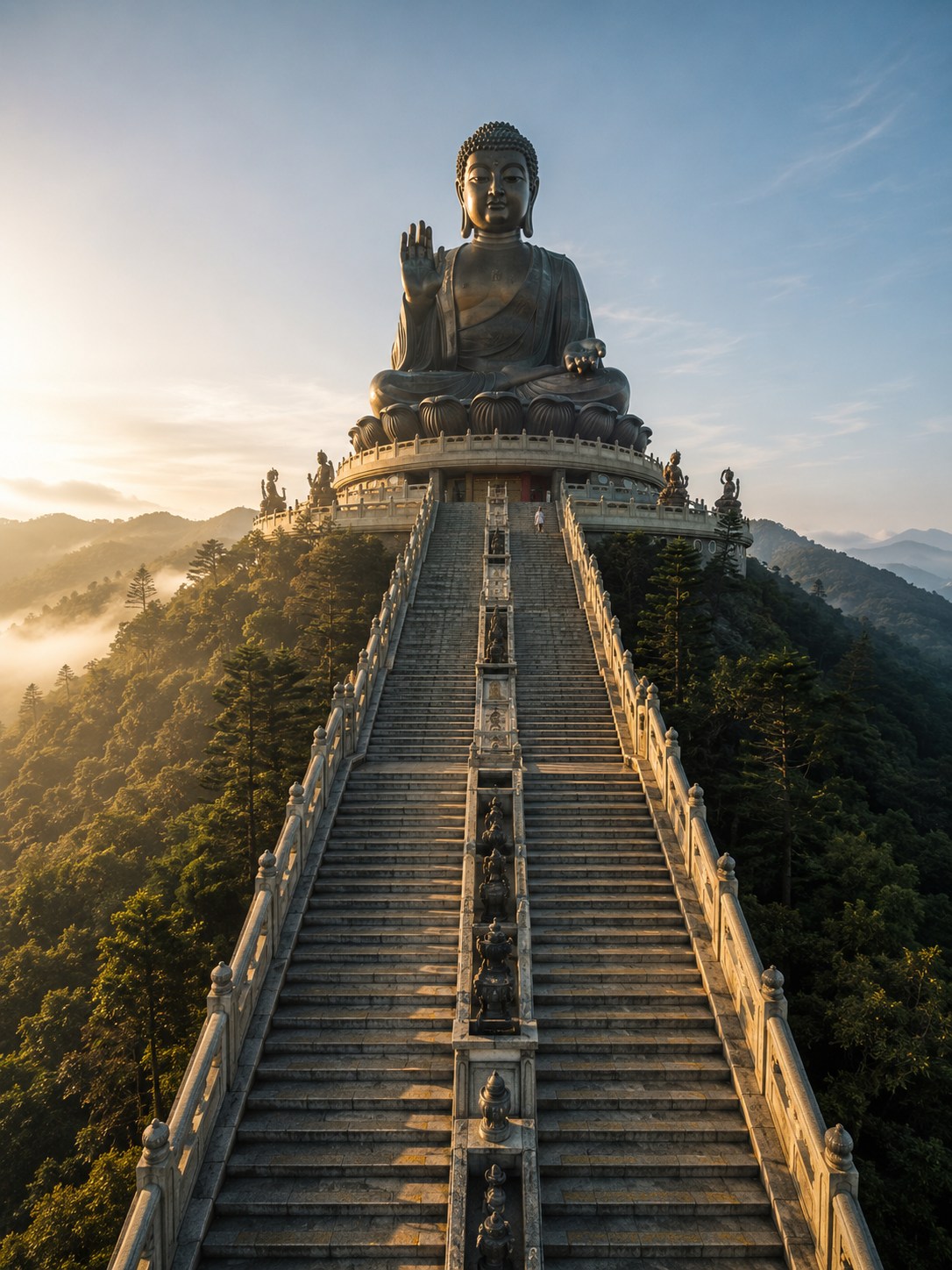
Two hundred and sixty-eight steps, taken slowly, in the one hour the mist lifts. Illustrative image
The Ngong Ping 360 cable car is twenty-five minutes and 5.7 kilometres of the best approach to any monument in Asia — out over Tung Chung Bay, up the flank of Lantau North, over the airport runway on one side and the South China Sea on the other, and then the Buddha appears on his hilltop across the valley and everyone on board stops talking. Pay for a Crystal Cabin with the glass floor; it is a modest premium and it is the whole point.
Tian Tan Buddha was completed in 1993, sits thirty-four metres high, weighs two hundred and fifty tonnes, and is reached by two hundred and sixty-eight steps. His right hand is raised to remove affliction and his left rests open in giving. Take your time at the top, then go into Po Lin Monastery below and eat the vegetarian lunch in the refectory, which is prepared by the monks and is genuinely excellent rather than merely worthy. In the afternoon, take the bus to Tai O — a Tanka fishing village on the western tip of the island where the houses are built on stilts over a tidal creek, shrimp paste ferments in vats along the waterfront, and dried fish hangs from every available rail. It is the last place in Hong Kong that looks the way all of Hong Kong once looked.
Insider Notes
- Go on a weekday and go early. The cable car queue on a Saturday can run past ninety minutes. Book a timed slot online, take the first cabin of the day, and you will have the Buddha in soft light with room to breathe.
- Check the weather before you commit. The cable car suspends in high wind and the Buddha spends a good deal of the year inside cloud. If the forecast is poor, swap this day with Sai Kung and go later in the week — this is the one day on the itinerary that genuinely depends on visibility.
- The vegetarian meal ticket at Po Lin is bought at the base of the steps, not at the refectory. Buy it when you arrive, eat when you come down.
- Tai O is forty minutes from Ngong Ping on Route 21, or twenty minutes by taxi. The stilt houses are people's homes — the boat tour through the creek is the respectful way to see them, and it usually runs out to look for the pink dolphins as well, though sightings are far from guaranteed and the population is in serious decline.
- Buy the shrimp paste in Tai O if you want a souvenir with a story, but check your home country's import rules first, and pack it in something sealed. It is pungent in a way that will end a friendship inside a suitcase.
Where to Eat
- Lunch — The vegetarian refectory at Po Lin Monastery. Simple, generous, served at communal tables, and about as far from a theme-park lunch as it is possible to get.
- Afternoon — In Tai O: a charcoal-grilled squid or a bowl of tofu flower from a stall on the main street, and a Tai O egg waffle. Solo Coffee, above the creek, does a decent flat white and a view.
- Dinner — Back in town. Tung Po in North Point, a legendary dai pai dong-style operation on the first floor of a municipal market building where beer is served in ceramic rice bowls and the owner has been known to DJ. Loud, chaotic, wonderful, and you must book.
Tickets & Costs
| Ngong Ping 360 return, Standard Cabin | HKD 270 |
| Ngong Ping 360 return, Crystal Cabin | HKD 345 |
| Tian Tan Buddha, exterior and steps | Free |
| Po Lin Monastery vegetarian meal | HKD 138 |
| Tai O boat tour, 20 minutes | HKD 30 |
| Bus, Ngong Ping to Tai O | HKD 12 |
Day 4 · Kowloon
A Tang Dynasty Garden, and Every Market in Mong Kok
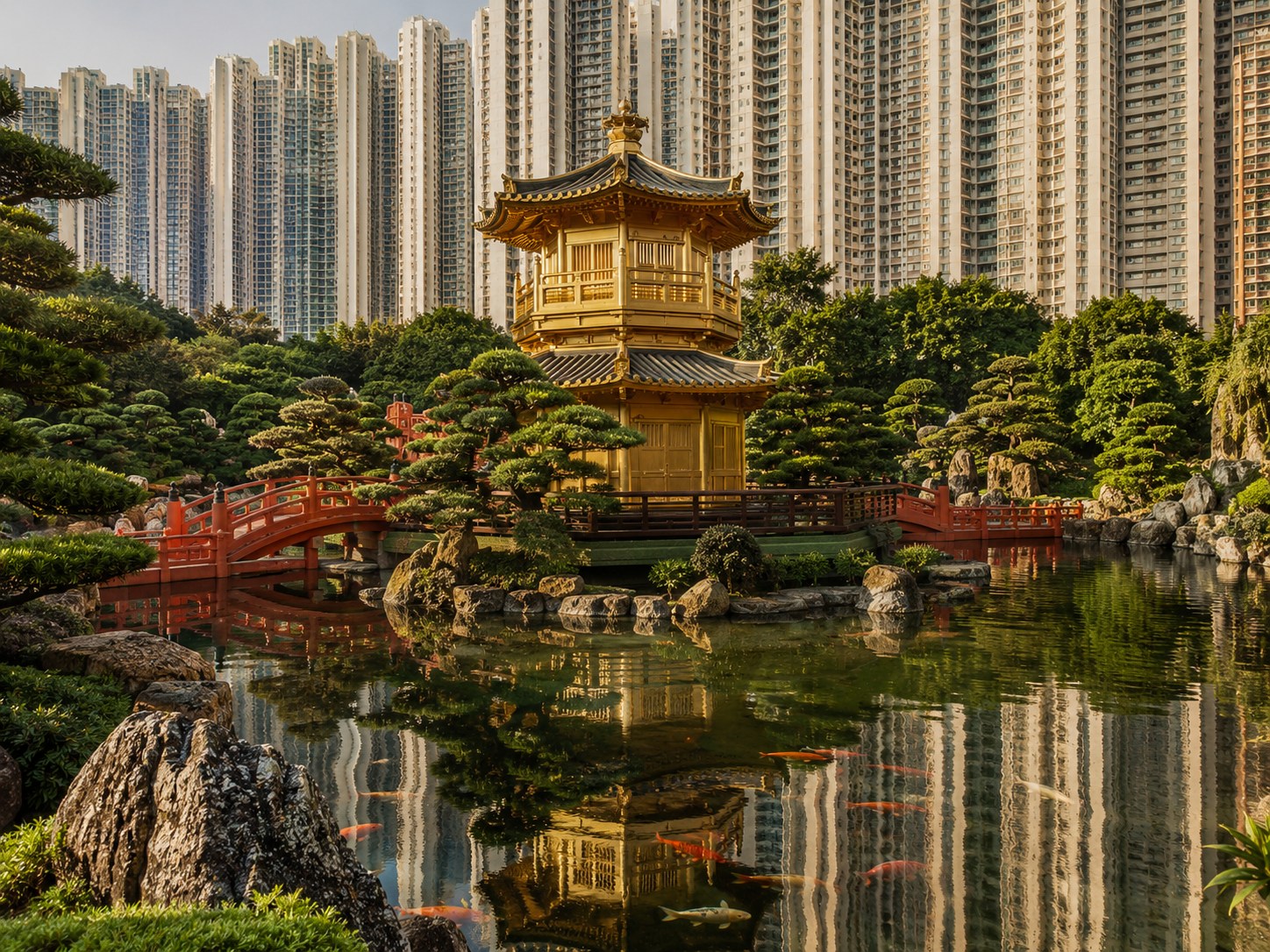
A thousand-year-old garden with a housing estate for a sky. Hong Kong does not apologise for this. Illustrative image
Nan Lian Garden is the most surprising place in Hong Kong. It is a Tang dynasty landscape garden, built in 2006 to a classical plan, with every rock, pine and water course positioned according to a system a thousand years old — and it sits directly beneath a wall of Diamond Hill apartment towers with a flyover running past the perimeter. That collision is the point, and rather than ruining it the towers make it. The golden Pavilion of Absolute Perfection stands on an island in a lotus pond, reached by two vermilion bridges. Cross the footbridge to Chi Lin Nunnery, a complex of Tang-style timber halls built entirely without nails, using traditional interlocking joinery. Both are free. Both are quiet in a way almost nowhere else in this city is.
Then swing hard the other way. Wong Tai Sin Temple is two MTR stops away and is the busiest working temple in Hong Kong — Taoist, Buddhist and Confucian at once, wreathed in smoke, and full of people shaking bamboo fortune sticks until one falls out. Carry on to Mong Kok for the afternoon and walk the market streets in sequence: the Flower Market on Flower Market Road; the Yuen Po Street Bird Garden, where old men bring their songbirds in bamboo cages, hang them from hooks, and sit drinking tea while the birds compete; the Goldfish Market on Tung Choi Street North, where whole shopfronts are papered in plastic bags of live fish; Sneaker Street on Fa Yuen Street; and the Ladies' Market. End at Temple Street after dark for the night market, dinner at a street table, and a fortune teller if the mood takes you.
Insider Notes
- Nan Lian and Chi Lin close by six. Go in the morning, when the light comes over the towers and the koi are being fed. There is a vegetarian restaurant tucked behind a man-made waterfall inside Nan Lian that is one of the genuinely hidden pleasures of Kowloon.
- The Bird Garden is at its best between eight and eleven in the morning, when the regulars are actually there. By mid-afternoon it is mostly shuttered. If you want it properly, do Kowloon in reverse — birds and flowers first, gardens after.
- Temple Street was relaunched in December 2023 with a proper food-stall zone, Cantonese opera singers and fortune tellers after two thin decades. It is better than it has been in years, but it is still a tourist market — go for the atmosphere and the clay-pot rice, not the shopping.
- Haggling is expected at Ladies' Market and Temple Street, and nowhere else. Start at roughly half, settle around sixty per cent, and walk away cheerfully if it does not work. Do not haggle in shops, restaurants or the Goldfish Market.
- Wong Tai Sin has a dress code in practice if not on paper. Cover shoulders and knees. The fortune-stick reading — kau cim — costs a small amount at the arcade behind the main hall, and several readers speak English.
Where to Eat
- Lunch — Chi Lin Vegetarian, behind the waterfall at Nan Lian Garden. Reserve; it is small and it fills with people who know.
- Afternoon — Mong Kok street food, done properly: curry fish balls, stinky tofu if you are brave, an egg waffle from Lee Keung Kee, and a cup of milk tea from any cha chaan teng with a queue.
- Dinner — A clay-pot rice at a street table on Temple Street; Hing Kee is the name people go for. Or, ten minutes away in Jordan, Kai Kai Dessert for a late bowl of black sesame soup.
- Sweet — Egg waffle, eaten walking, torn apart bubble by bubble. Non-negotiable.
Tickets & Costs
| Nan Lian Garden | Free |
| Chi Lin Nunnery | Free |
| Wong Tai Sin Temple / fortune sticks | Free / HKD 30–60 |
| Yuen Po Street Bird Garden | Free |
| Street food, per person, generously | HKD 100–150 |
Day 5 · Sai Kung
A Supervolcano, a Tombolo, and a Fish You Choose Yourself
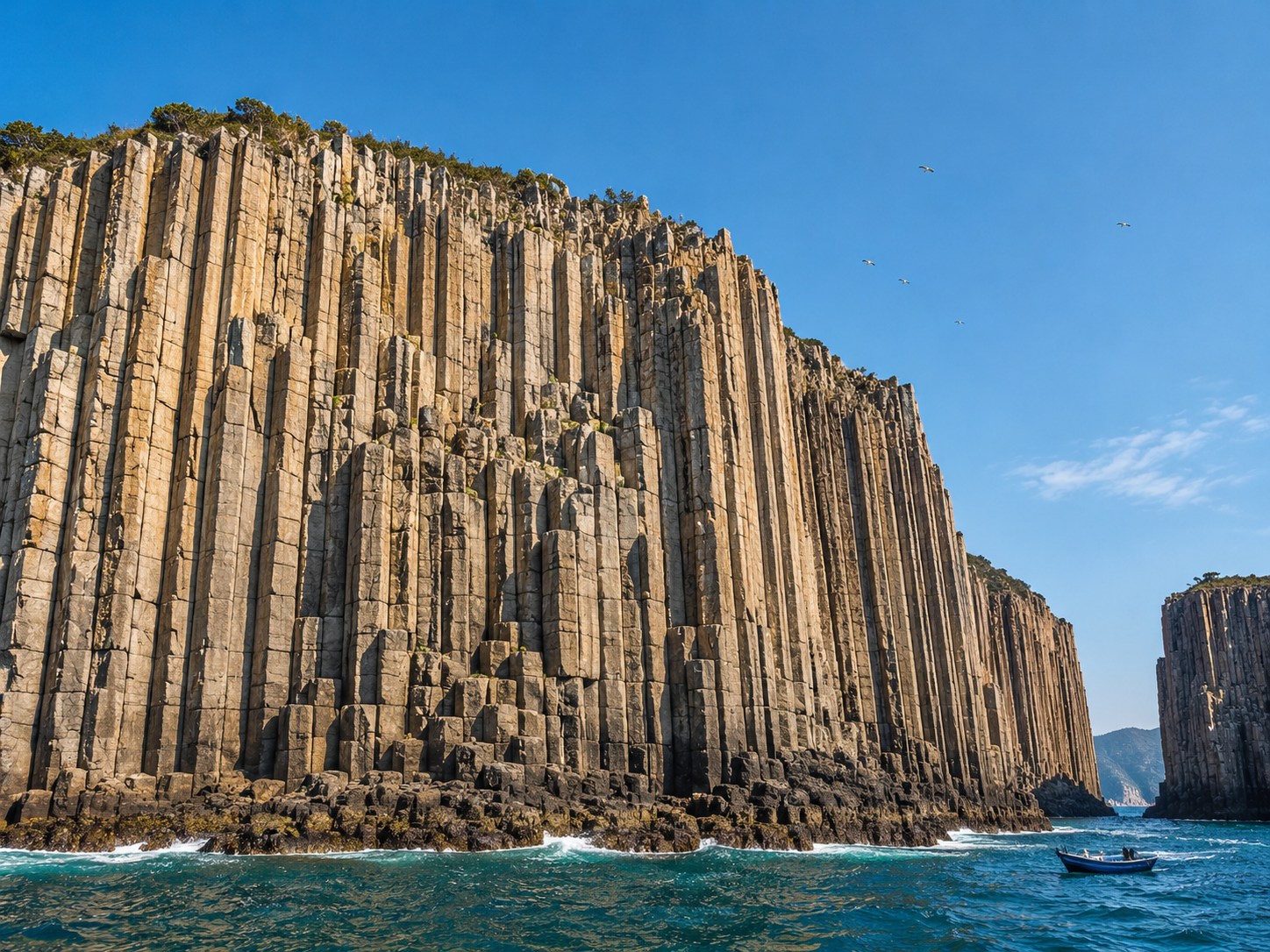
A hundred and forty million years ago this was a supervolcano. It has been quiet ever since, and enormous. Illustrative image
Almost nobody who visits Hong Kong knows this, and it is the most surprising fact about the territory: the eastern New Territories sit on the remains of a supervolcano that erupted roughly a hundred and forty million years ago, and the cooling ash left behind the largest field of hexagonal volcanic rock columns anywhere on earth — over a hundred square kilometres of them, some rising a hundred metres out of the sea. They are unusual as well as vast. Most columnar formations in the world, from the Giant's Causeway to Fingal's Cave, are dark basalt; Hong Kong's are pale, silica-rich rhyolite, which makes them look less like rock and more like an enormous pipe organ carved out of bone.
Take a bus or taxi to Sai Kung town — forty minutes from Kowloon and a different world, a fishing port with a working waterfront where the boats still tie up and sell directly off the deck. Board a speedboat at the pier for the two-hour Geopark circuit: the Shore of a Hundred Thousand Columns at High Island, the Organ Cliff and the narrow God Cut Strait at Po Pin Chau, and the sea arches and caves of the Ung Kong group, several of which the boat will take you directly through if the swell allows. Stop at Sharp Island on the way back, where a natural sand tombolo emerges at low tide and lets you walk across open water to a second island, past granite boulders so weathered and cracked they are locally known as the Pineapple Bun Rocks.
Come back into Sai Kung in the late afternoon and eat on the seafood street, where the restaurants keep their stock in tanks along the pavement and the transaction is simple: you point, they weigh it, you say how you want it cooked, and twenty minutes later it arrives. It is the best value fine seafood in Hong Kong and there is not a tour bus in sight.
Insider Notes
- Book the boat and check the sea state the night before. The two-hour speedboat tours run daily year-round from Sai Kung pier and cost around HKD 400 to 500 per person, but the operators will not enter the sea arches in heavy swell, which is the best part. Morning departures are calmer than afternoons in almost every season.
- The land alternative is the High Island Reservoir East Dam, where you can walk right up to a wall of columns on the 1.4-kilometre High Island Geo Trail and see a fault breccia belt and a section of S-shaped columns twisted by tectonic movement before they finished solidifying. It is free and spectacular, but public transport out there is slow and taxis back can be scarce — take the boat unless you specifically want to touch the rock.
- Get there on bus 92 from Diamond Hill MTR (about forty-five minutes) or take a taxi, roughly HKD 250 from Kowloon and worth it for two people. Sai Kung town itself is entirely walkable.
- Sharp Island's tombolo only exists at low tide. Check the tide table before you book, and tell the operator you want to walk it — it is a genuinely strange thing to do and takes about twenty minutes there and back.
- Optional, and only on a Wednesday — Happy Valley racecourse. If any night of the trip falls on a Wednesday between September and July, this is the most purely Hong Kong evening available: a floodlit racetrack from 1846 ringed on all sides by apartment towers, a beer garden with live bands between races, and a crowd of locals, expats and off-duty everybody. Public enclosure admission is HKD 10 by Octopus, and visitors aged 18 or over holding a foreign passport currently enter free. Take the tram to Happy Valley terminus. Bet small, bet on everything, and do not wear flip-flops — the dress code is enforced.
- Sai Kung is where Hong Kong people go at weekends, which means Saturday and Sunday are busy and the boats fill. Go midweek if the itinerary allows.
Where to Eat
- Lunch — On the boat, or a quick bowl at Sai Kung pier before departure. Keep it light; the point of the day is dinner.
- Dinner — The seafood street on the Sai Kung waterfront. Chuen Kee Seafood is the best-known and reliably good — pick from the tanks, then have the mantis shrimp salt-and-pepper fried, the razor clams steamed with garlic and vermicelli, and a whole steamed grouper. For something more refined, Loaf On is a Michelin-starred Cantonese restaurant a street back from the water, in an unassuming four-storey shophouse.
- Sweet — Honeymoon Dessert began in Sai Kung in 1995 and is now all over Asia; the original branch is still here. Mango with pomelo and sago, eaten looking at the boats.
- If you took the Happy Valley option — eat at the racecourse. It is better than it has any right to be, and Kam's Roast Goose in Wan Chai is a ten-minute taxi afterwards.
Tickets & Costs
| Geopark speedboat tour, 2 hours, per person | HKD 400–500 |
| Geopark full-day island-hopping boat, per person | HKD 700–900 |
| High Island Geo Trail and East Dam | Free |
| Bus 92, Diamond Hill to Sai Kung | HKD 7 |
| Sai Kung seafood dinner, per person | HKD 300–500 |
| Happy Valley, public enclosure (optional) | HKD 10, or free with passport |
Day 6 · Kowloon
Sham Shui Po, M+, and the Highest Bar in the World
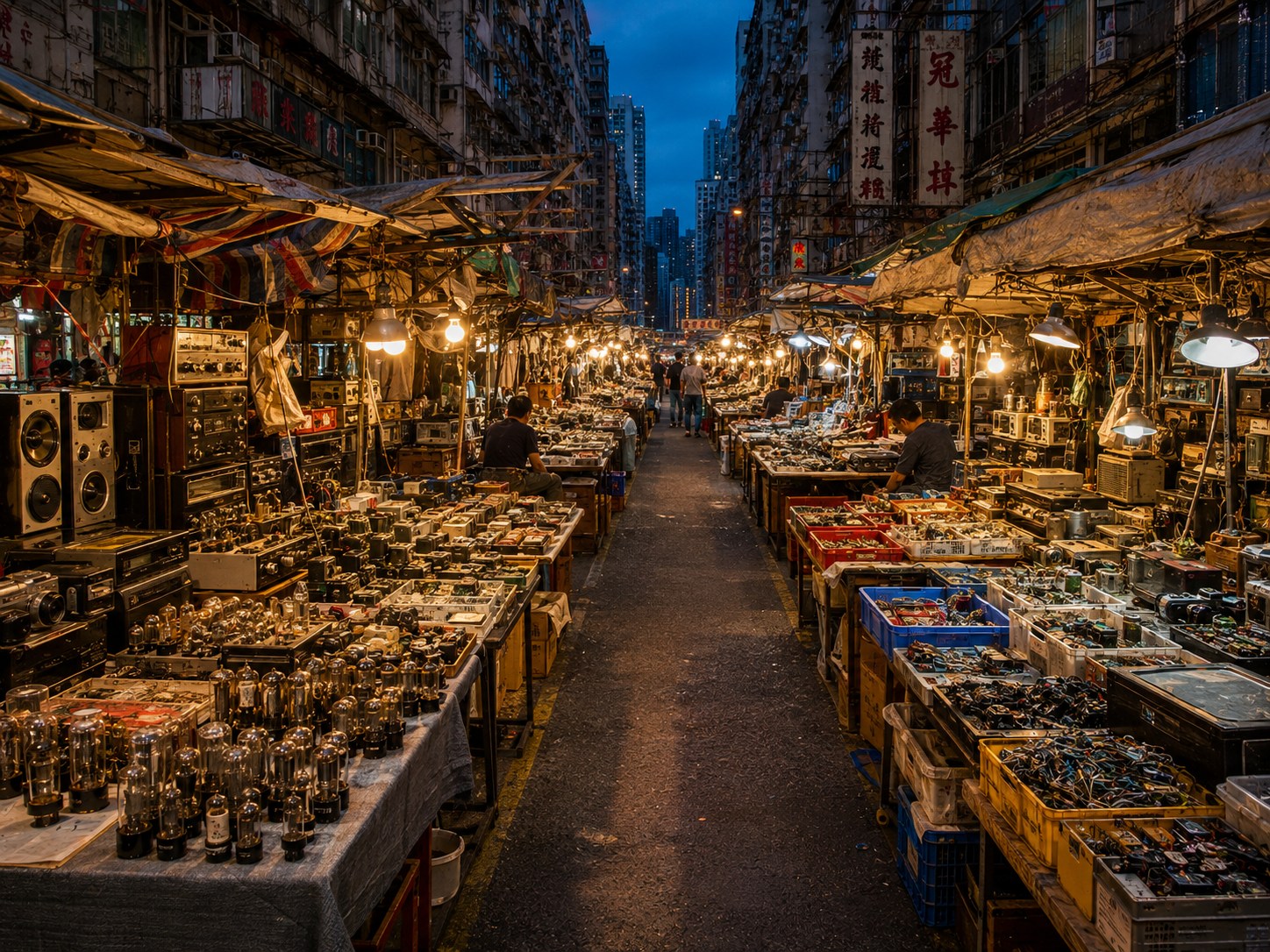
Every valve, lens and length of cable the city ever needed, still for sale, still under a bare bulb. Illustrative image
Sham Shui Po is the poorest district in Hong Kong and it is the most interesting one. Give it the whole morning. Apliu Street is a hundred-year-old flea market that has evolved into an electronics bazaar — trestle tables of vacuum tubes, vintage cameras, Soviet lenses, salvaged circuit boards, hi-fi separates, and men who can identify a component by weight. Around it, the streets specialise so precisely it feels invented: Yu Chau Street sells buttons and ribbon, Ki Lung Street sells beads and zips, Nam Cheong Street sells fabric by the bolt, and Ap Liu's north end sells nothing but plugs. This is where Hong Kong's garment industry buys, and where the city's designers and film costumers still come.
In the afternoon, move down to Yau Ma Tei. Shanghai Street is the restaurant-supply street — hand-forged woks, bamboo steamers in every diameter, hardwood chopping blocks cut from single trunks, and cleavers sharpened while you wait. It is the best shopping in Hong Kong for anyone who cooks, and nothing in it is aimed at tourists. Then the Jade Market under the flyover, the Tin Hau Temple and its banyan square, and the Yau Ma Tei Fruit Market, a 1913 wholesale market of low stone sheds that comes alive after dark.
Give the last part of the day to West Kowloon, which is fifteen minutes away and which most itineraries written before 2022 do not mention at all. M+ opened in November 2021 in a Herzog & de Meuron building shaped like an inverted T, and it is the most significant museum to open anywhere in Asia in decades — visual culture rather than fine art, meaning design, architecture, moving image and the largest collection of Chinese contemporary art in the world, including the Uli Sigg collection. Next door, the Hong Kong Palace Museum opened in July 2022 and shows rotating loans from the Forbidden City in Beijing, much of which has never left the mainland before. Then go up: Ozone, on the 118th floor of the Ritz-Carlton in the ICC tower, is the highest bar in the world and is a five-minute walk from the museums. On a clear night the whole of Hong Kong is laid out underneath the glass.
Insider Notes
- Go to Sham Shui Po in the morning, before noon. Many of the trade streets close in the early afternoon, and Apliu Street is at its densest and best between ten and one.
- Bring cash. A great many of these stalls do not take cards, and some do not take Octopus either. There are ATMs on Cheung Sha Wan Road.
- Buy the wok at Shanghai Street, not at the airport. A carbon-steel wok with a wooden handle costs a fraction of what it does anywhere in the West, weighs very little, and will outlive you. Ask them to season it before you take it.
- M+ is closed Mondays; the Palace Museum is closed Tuesdays. They are five minutes apart and five minutes from Ozone, which makes this the tidiest afternoon-to-evening sequence in Kowloon. Give M+ at least two hours and start on the second floor rather than the ground.
- Ozone has a dress code and it is enforced — no shorts, no flip-flops, no sportswear, no sleeveless shirts on men. Book, arrive before sunset for a window table, and accept that the drinks are priced for the altitude.
- The Jade Market is for browsing, not investing. Genuine high-grade jadeite is not sold from a folding table under a flyover. Buy something because you like it at the price you paid, and enjoy the haggling.
Where to Eat
- Breakfast — Kung Wo Beancurd Factory on Pei Ho Street, making tofu by hand since the 1960s. Tofu flower with brown sugar syrup, and deep-fried tofu on the side.
- Lunch — Lau Sum Kee on Fuk Wing Street, one of the last families in Hong Kong still pressing noodles the traditional way, with a bamboo pole and body weight. Order the dry shrimp roe noodles.
- Dinner — Kwan Kee Claypot Rice on Queen's Road West, cooked over charcoal, ordered before you sit down because it takes half an hour. Ask for the crust at the bottom. Or head to Kowloon City for Islam Food's veal goulash and its famous beef pancake.
- Sweet — Hop Yik Tai on Kweilin Street for cheung fun — steamed rice rolls with sesame, sweet sauce and peanut butter, eaten from a polystyrene box on the pavement.
Tickets & Costs
| Apliu Street, Shanghai Street, Jade Market | Free to browse |
| Carbon-steel wok, Shanghai Street | HKD 150–350 |
| M+ museum, standard admission | HKD 120 |
| Hong Kong Palace Museum, standard / with specials | HKD 60 / 150 |
| Ozone, cocktails from | HKD 180 |
| Sham Shui Po street food, per person | HKD 60–120 |
Day 7 · Macau
The Ferry South, and the Cotai Strip by Night
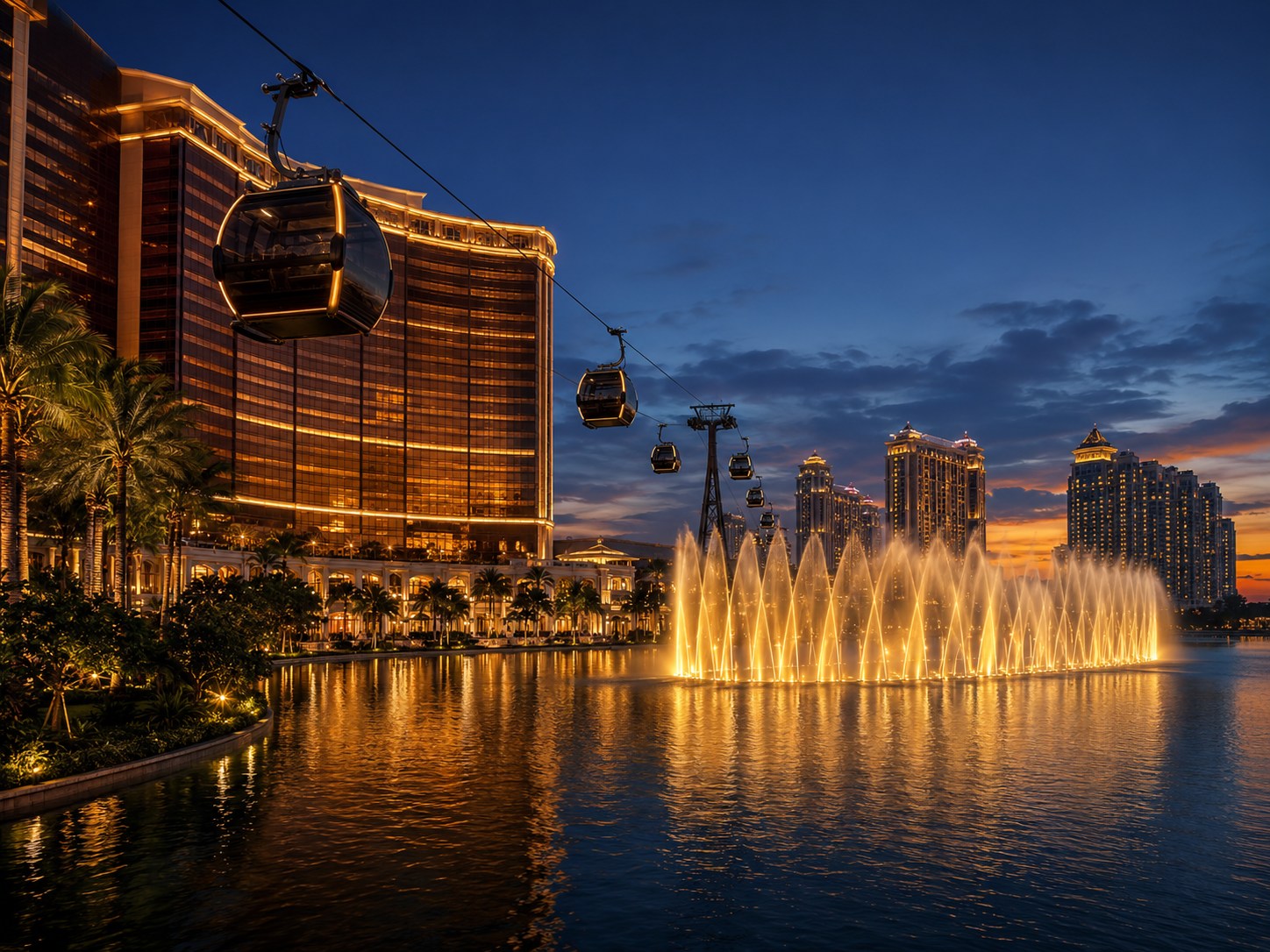
Macau spent four hundred years being Portuguese and about twenty becoming this. Illustrative image
The TurboJET from Hong Kong takes about an hour across the Pearl River Delta and puts you into a place that has no real equivalent anywhere. Macau was Portuguese for four hundred and forty-two years, returned to China in 1999, and now takes several times the gaming revenue of Las Vegas from a territory a fraction the size. Cotai — the reclaimed strip between Taipa and Coloane — is where that money built itself a skyline.
Start at the Venetian, which is the largest casino building on earth by floor area and contains a canal system with gondoliers who sing, under a painted sky that is permanently set to late afternoon. It is absurd, and it is worth seeing precisely because the absurdity is executed at a scale Vegas never attempted. Walk over to Wynn Palace and ride the SkyCab, a gondola lift that carries you in a slow arc over the Performance Lake — it is free, it takes about eight minutes, and the fountains run beneath you to music. Then in the evening cross to the peninsula for the Grand Lisboa, the gold lotus-shaped tower that is the most recognisable building in Macau: in its lobby sits the Star of Stanley Ho, a 218-carat diamond, alongside a serious collection of jade and ivory carvings. Its casino floor is the oldest-school of the three and much the most local in feel.
Insider Notes
- Macau is a separate jurisdiction with its own immigration, currency and visa rules. You clear immigration in both directions even coming from Hong Kong. Bring your passport, not just an ID card, and check your own nationality's visa position before booking — most Western passports get thirty days visa-free, Indian passports thirty days, but this changes.
- Every casino runs free shuttle buses from the ferry terminals and the border, and you do not have to be a guest. They are frequent, air-conditioned and the way locals move around Cotai. There is very little reason to take a taxi.
- Macau's patacas are pegged to the Hong Kong dollar and every business takes HKD at par, which means you lose a couple of per cent on every transaction but save a great deal of hassle. Do not bother changing money for a short stay. Note that change will often come back in patacas, which are not accepted in Hong Kong.
- Baccarat, not slots, is the game here — it accounts for the overwhelming majority of table revenue, and the floors are laid out accordingly. Minimum bets on Cotai run high, typically from HKD 500 to 1,000 a hand on the main floor; the older peninsula casinos like the Lisboa have lower minimums and considerably more atmosphere.
- Photography is prohibited on every casino floor in Macau, and security will stop you. Put the phone away as you cross the threshold.
Where to Eat
- Lunch — On the ferry or at the Venetian's food court, which is better than that sounds. Or hold out for the evening.
- Dinner — Robuchon au Dôme on the 43rd floor of the Grand Lisboa: three Michelin stars, a glass dome, and a wine list of roughly seventeen thousand bottles that is among the largest in any restaurant in the world. It is a serious expense and a serious occasion. For something a third of the price and nearly as memorable, The Eight downstairs holds three stars for Cantonese and dim sum.
- Late — The Golden Peacock at the Venetian, which was the first Indian restaurant anywhere to hold a Michelin star. Given how far you have come, it is an oddly delightful thing to find here.
Tickets & Costs
| TurboJET, Hong Kong to Macau, economy, per person | HKD 175–250 |
| Casino shuttle buses | Free |
| Venetian gondola ride, per person | MOP 158 |
| Wynn Palace SkyCab and Performance Lake | Free |
| Grand Lisboa lobby, Star of Stanley Ho | Free |
Day 8 · Macau
Four Hundred Years of Portugal, and a Water Show
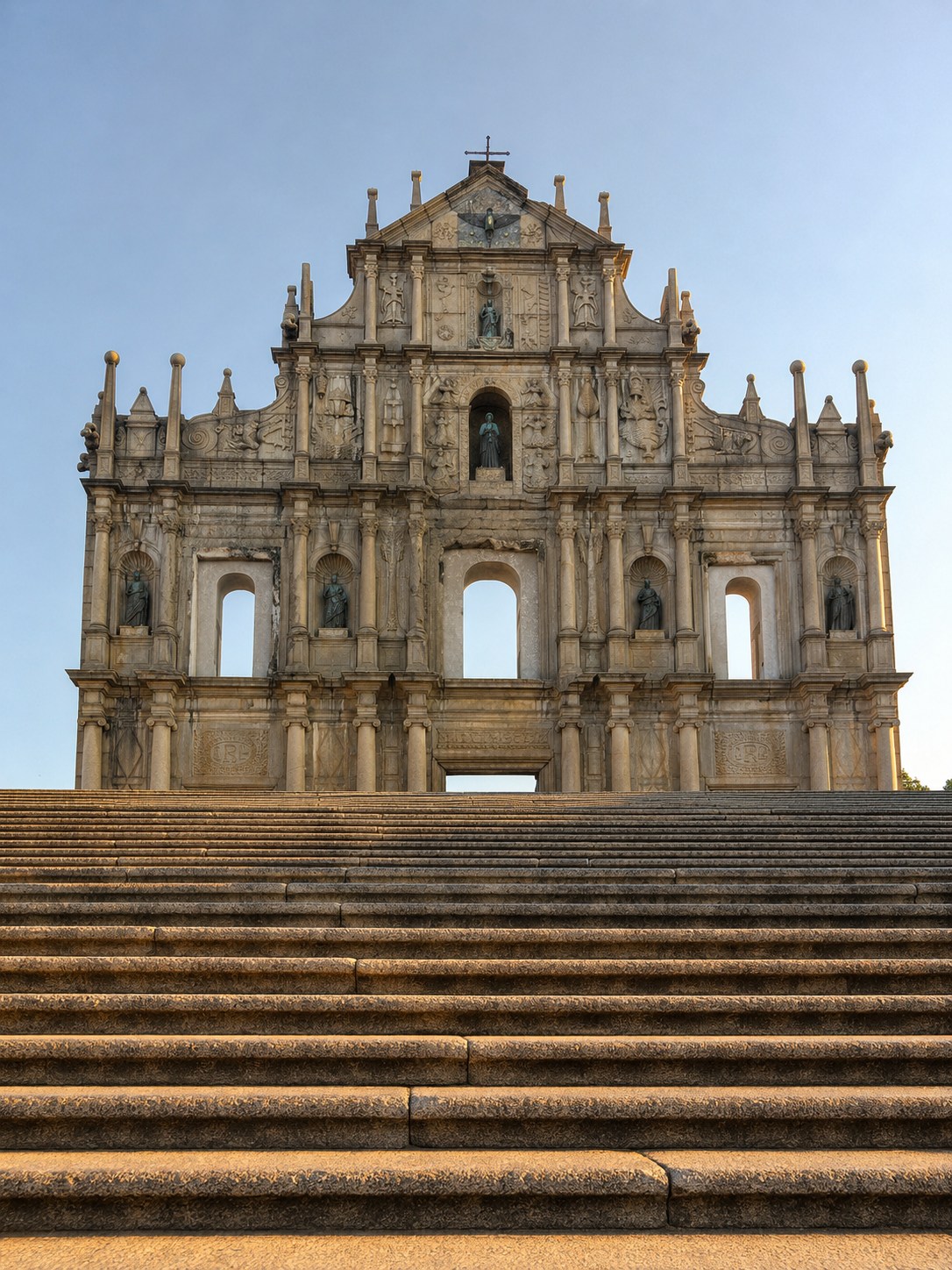
A church that burned in 1835 and became more famous as a wall. Illustrative image
The Historic Centre of Macau is a UNESCO World Heritage Site of more than twenty buildings and squares, and it is genuinely extraordinary — not a preserved quarter but a living one, where Portuguese baroque churches sit on Chinese streets and the two traditions have been arguing productively for four centuries. Start early at Senado Square with its Portuguese calçada paving in black and white waves, then climb to the Ruins of St Paul's. The church burned in 1835 and what remains is the granite façade alone, standing at the top of a broad staircase like a piece of stage scenery — a five-tier frontage carved with Jesuit saints, a Chinese dragon, a Japanese chrysanthemum and a Portuguese sailing ship, because the masons were Japanese Christian exiles working for Italian Jesuits in a Chinese port.
Walk the rest on foot: Mount Fortress and the Macau Museum behind it, Rua da Felicidade with its red shutters, the Mandarin's House, the Moorish Barracks, and A-Ma Temple at the southern tip — built in 1488, older than the city, and the origin of the name Macau itself. In the evening, take in the House of Dancing Water at City of Dreams, which reopened in May 2025 after a three-year hiatus, reimagined by Giuliano Peparini: a purpose-built theatre whose stage floor sinks to become a pool holding seventeen million litres of water, with divers, aerialists and motorcycles. It is the best commercial show in Asia.
Insider Notes
- Do the heritage walk before ten in the morning. By eleven the Ruins of St Paul's staircase is a solid mass of people and tour flags. Before nine it is nearly empty and the light on the façade is far better.
- Book House of Dancing Water well ahead, and book fourteen days out for the discount. Tickets run from around MOP 698 to MOP 1,598. Show times in the June to October season are typically 4:30pm and 7:30pm, but the theatre goes dark for maintenance periods — it is closed 7 to 22 September 2026 — so confirm your date before you fix the rest of the day.
- The front rows are a genuine splash zone. They will tell you this and people do not believe it. If you would rather stay dry, sit further back and higher; the staging reads better from a middle tier anyway.
- Macau's streets are steep, narrow and cobbled. The heritage centre is entirely walkable but not in new shoes. There is also almost no shade — a hat between May and September is not optional.
- The Macau Grand Prix Museum near the ferry terminal is free and unexpectedly excellent, with simulators and the actual cars. The Guia Circuit is a street circuit that has run since 1954 and the museum sits inside the track.
Where to Eat
- Breakfast — A pork chop bun from Tai Lei Loi Kei in Taipa Village. A fried chop, bone in, in a crisp roll, and nothing else. Sold from mid-morning until they run out.
- Lunch — Macanese, which exists nowhere else on earth. It is the world's oldest fusion cuisine — Portuguese technique with African, Indian, Malay and Cantonese ingredients, developed over four centuries by families who were both. Riquexó, a tiny canteen run for decades by the late Aida de Jesus's family, is the most authentic; Litoral on Rua do Almirante Sérgio is the more polished option. Order minchi, African chicken, and tacho if it is on.
- Dinner — After the show, at City of Dreams. Your ticket carries a discount at a long list of restaurants on the night and the day after, which is a genuinely useful perk rather than a token one.
- Sweet — Serradura, the Macanese 'sawdust pudding' of cream and crushed Marie biscuits. Simple, cold, and dangerously easy to eat two of.
Tickets & Costs
| Ruins of St Paul's and Senado Square | Free |
| Macau Museum | MOP 15 |
| Mandarin's House / A-Ma Temple | Free |
| Macau Grand Prix Museum | Free |
| House of Dancing Water, per person | MOP 698–1,598 |
Day 9 · Coloane
Black Sand, an Egg Tart, and the Village at the End of the Road
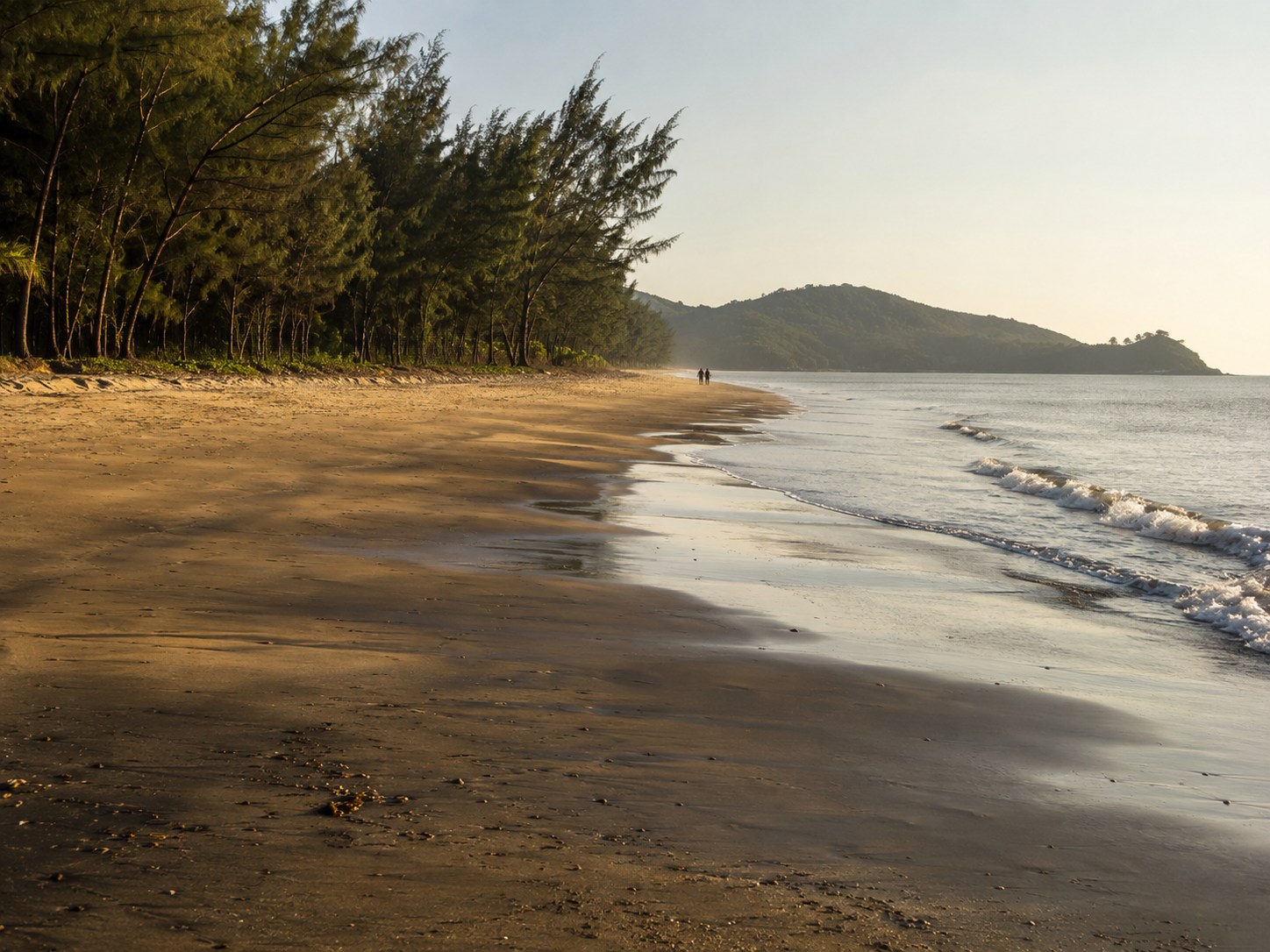
The road runs out, the towers vanish, and Macau remembers it is an island. Illustrative image
Coloane is the southern island and it is the antidote to everything else in this itinerary. It was never reclaimed, never redeveloped, and until the 1990s it was mostly known for pirates. Coloane Village is a handful of pastel streets around a small square, with the Chapel of St Francis Xavier at one end and the sea at the other, and it is where Macau goes on a Sunday. Start there. Have an egg tart at Lord Stow's Bakery, which is where the Macanese egg tart was invented in 1989 by Andrew Stow, an English pharmacist who reverse-engineered the Portuguese pastel de nata and made it better by using less sugar and more cream. His sister still runs it. His ex-wife runs a competing shop across the water in the city, and locals will argue about the two for as long as you let them.
Then take the afternoon at Hac Sa. It is the largest natural beach in Macau and its name means, literally, black sand — the colour comes from minerals washed down from the hills. You should know that erosion has been serious enough that the government has replenished the beach with ordinary yellow sand, so it is far less black than it was twenty years ago; patches of the original remain, mostly at the eastern end and after rain. It is still a good beach and a genuinely lovely afternoon: casuarina trees, a long flat curve of shoreline, barbecue pits, almost nobody. Water quality varies and is not tested continuously, so swim on judgement and not within three days of heavy rain. Then eat at Fernando's, and understand why people take a forty-minute bus ride to do so.
Insider Notes
- Buses 15, 21A, 25 and 26A all reach Hac Sa and cost a few patacas; a taxi from Cotai runs about MOP 75 and is often no faster. Coloane Village and Hac Sa are on the same bus route about ten minutes apart.
- Fernando's takes no reservations, no credit cards and no arguments. It is a brick building with a bare dining room and a separate bar out the back where you wait. Order the suckling pig, the clams in garlic, the salad and a bottle of Portuguese red. It has been doing exactly this since 1986 and it has never once been fashionable, which is precisely why it is still good.
- Lord Stow's tarts come out of the oven on a schedule and are best within twenty minutes. Ask when the next batch lands and wait for it. The garden café around the corner from the main shop is where to sit down.
- The Macao Giant Panda Pavilion at Seac Pai Van is on the way and costs MOP 10. It is small, it is genuinely uncrowded, and the country park it sits in is pleasant.
- Check the beach before you commit to swimming. The municipal authority publishes water quality assessments, and the sand is cleaned daily but litter after weekends is real. Treat it as a place to walk, sit and eat rather than a resort beach and it will not disappoint you.
Where to Eat
- Morning — Lord Stow's Bakery, Coloane Village. Two tarts each, minimum. The caramelised top should crack.
- Lunch or dinner — Fernando's at Hac Sa. Portuguese, unreconstructed, cash only, and one of the ten restaurants worth crossing a border for. If it is full, the barbecue stalls in the beach car park do superb grilled chicken wings for a tenth of the price.
- Alternative — Espaço Lisboa in Coloane Village, in an old two-storey house, doing serious Portuguese cooking in a quieter room. Or Nga Tim Café on the village square, under the trees by the chapel, for clams and chilli garlic prawns.
- Sweet — The egg tart already counts. If you insist, almond cookies from Koi Kei, pressed and baked in front of you.
Tickets & Costs
| Bus to Coloane and Hac Sa | MOP 6 per journey |
| Lord Stow's egg tart | MOP 12 |
| Hac Sa beach | Free |
| Macao Giant Panda Pavilion | MOP 10 |
| Fernando's, per person with wine | MOP 300–450 |
Day 10 · Departure
The Ferry That Skips an Entire Country
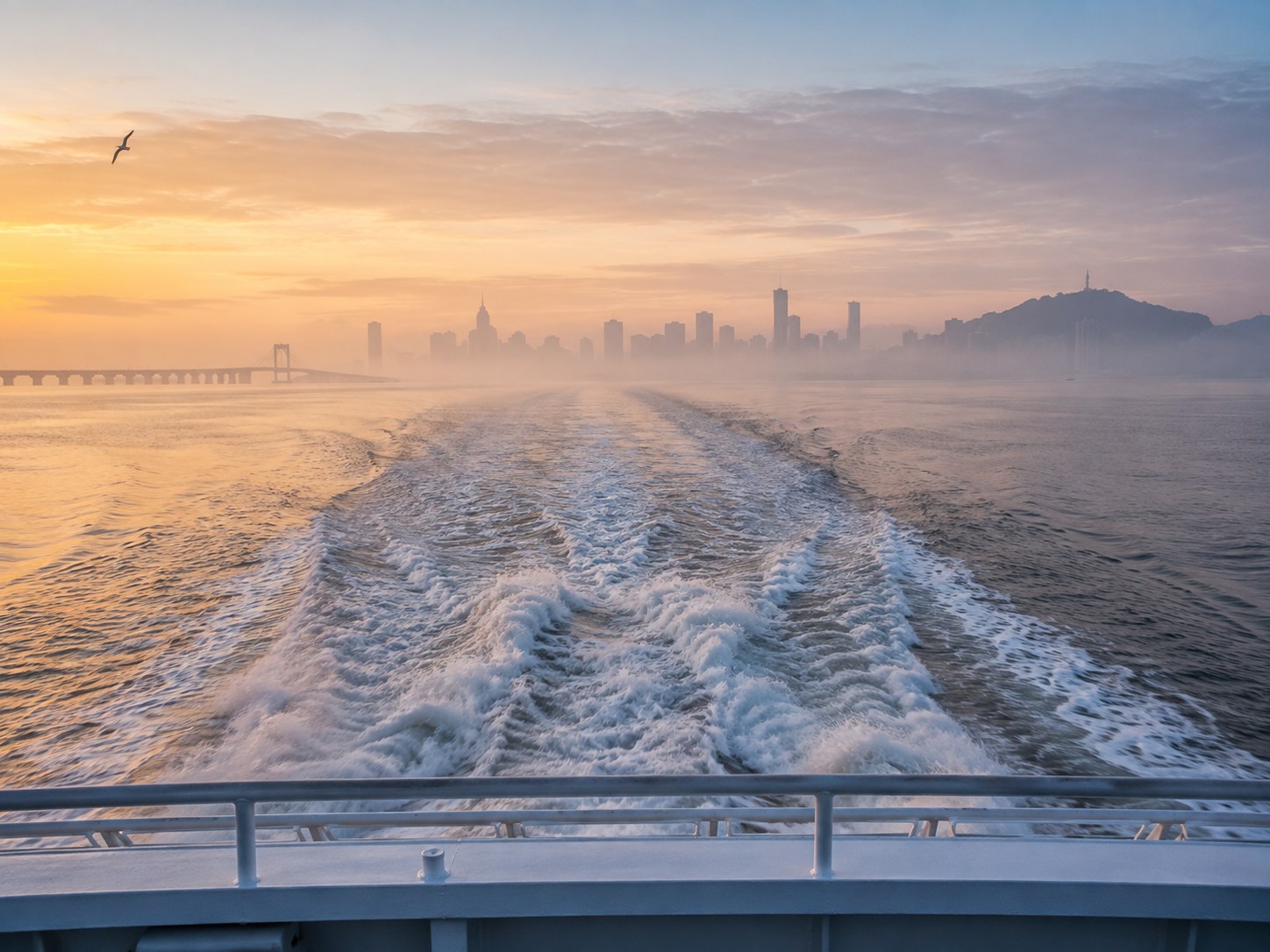
You should leave the way you arrived — by water, early, with the city dissolving behind you. Illustrative image
There is a piece of transport logistics here that almost nobody knows about and that is worth building your departure around. If you are flying out of Hong Kong International, you can take a ferry directly from the Macau Outer Harbour or Taipa terminal to the SkyPier at HKIA, check your bags in at the ferry terminal in Macau, and transfer straight airside to your gate — without ever clearing Hong Kong immigration. It saves an hour and a half and a great deal of luggage handling, and it costs about the same as the ordinary ferry.
Which leaves you the morning. Have a last pork chop bun in Taipa Village, walk Rua do Cunha, buy almond cookies and beef jerky from the shouting vendors who will hand you samples until you can no longer taste anything, and take one last look at the Cotai skyline from the Taipa Houses — five mint-green Portuguese villas from 1921, restored as museums, sitting on a hillside with the casinos rising directly behind them. It is the same collision you saw at Nan Lian Garden on Day 4, in a different key, and it is the right last image of this trip.
Insider Notes
- The SkyPier transfer must be booked as a through service and your airline must participate. Most major carriers do. You need to be at the Macau ferry terminal at least ninety minutes before sailing, and you cannot use it if you want to spend the day in Hong Kong first — it is airside only.
- If you are flying from Macau International instead, it is fifteen minutes from Cotai and one of the easiest airports in Asia. It is small; three hours is generous, two is enough.
- The Hong Kong–Zhuhai–Macau Bridge shuttle bus is the third option — about forty-five minutes to the Hong Kong side, then a bus to the airport. Cheaper than the ferry and useful in weather that stops the boats, which does happen in typhoon season.
- Do not carry patacas home. They are effectively unusable outside Macau and cannot be exchanged in Hong Kong at a sensible rate. Spend them at the airport or change them before you leave.
- Duty-free allowances between Macau and Hong Kong are separate from your home country's. If you have been buying wine at Robuchon or cigars anywhere, check both.
Where to Eat
- Breakfast — Taipa Village. A pork chop bun, a milk tea, and a walk down Rua do Cunha while the shops are still setting up.
Tickets & Costs
| Ferry, Macau to HKIA SkyPier, per person | HKD 270–320 |
| Ferry, Macau to Hong Kong city terminals, per person | HKD 175–250 |
| HZMB shuttle bus to Hong Kong, per person | HKD 65 |
| Taipa Houses-Museum | MOP 5 |
Ticket and Admission Summary
Everything on this itinerary, gathered in one place.
Per person unless stated.
Hong Kong · Days 1–6
| Octopus card, with initial stored value | HKD 150 |
| Airport Express, single / return | HKD 115 / 205 |
| Star Ferry, lower deck | HKD 5 |
| Hong Kong tram, any distance | HKD 3 |
| Peak Tram return with Sky Terrace 428 | HKD 148 |
| Peak Tram return only | HKD 88 |
| Ngong Ping 360 return, Standard / Crystal Cabin | HKD 270 / 345 |
| Po Lin Monastery vegetarian meal | HKD 138 |
| Tai O boat tour | HKD 30 |
| Geopark speedboat tour, 2 hours | HKD 400–500 |
| Geopark full-day island-hopping boat | HKD 700–900 |
| High Island Geo Trail and East Dam | Free |
| M+ museum, standard admission | HKD 120 |
| Hong Kong Palace Museum, standard / with specials | HKD 60 / 150 |
| Happy Valley public enclosure, Wednesdays Sept–July | HKD 10, free with foreign passport |
| Nan Lian Garden, Chi Lin Nunnery, Wong Tai Sin | Free |
| Man Mo Temple, Bird Garden, all markets | Free |
Macau · Days 7–10
| TurboJET, Hong Kong to Macau, economy | HKD 175–250 |
| Ferry, Macau to HKIA SkyPier on departure | HKD 270–320 |
| HZMB shuttle bus, alternative to the ferry | HKD 65 |
| Casino shuttle buses throughout Macau | Free |
| Wynn Palace SkyCab and Performance Lake | Free |
| Venetian gondola ride | MOP 158 |
| House of Dancing Water | MOP 698–1,598 |
| Macau Museum | MOP 15 |
| Macau Grand Prix Museum | Free |
| Ruins of St Paul's, A-Ma Temple, Mandarin's House | Free |
| Macao Giant Panda Pavilion | MOP 10 |
| Taipa Houses-Museum | MOP 5 |
| Macau Tower bungy jump, optional | MOP 3,088 |
Book before you leave home
- The Chairman, if you want it — six to eight weeks out, and it is the hardest table in Hong Kong.
- House of Dancing Water — book fourteen days ahead for the discount, and check the maintenance dark periods before you fix the day. The theatre is closed 7 to 22 September 2026.
- Ngong Ping 360 with a timed slot, and the Sai Kung Geopark boat the night before once you have seen the sea forecast.
- The Peak Tram Sky Pass with a timed entry, aimed at forty-five minutes before sunset.
- Ozone at the Ritz-Carlton for a window table at sunset, and Loaf On in Sai Kung if you want the Michelin-starred version of the seafood dinner.
- Bar Leone, Fernando's, Kau Kee, Sing Heung Yuen and Australia Dairy Company take no reservations at all. Turn up, expect to wait, and treat the queue as part of it.
Everything Else You Need to Know
Two territories, four immigration queues, one Octopus card.
Hong Kong and Macau are separate jurisdictions from mainland China and from each other, each with its own immigration, currency and visa policy. Carry your passport at all times, including on the day you cross to Macau — an ID card is not sufficient.
Two things that are date-locked
- Happy Valley racing is Wednesday nights only, September to July. If any night of the trip falls on a Wednesday in season, take it — see Day 5. If the dates are still flexible, moving the trip by a day to catch one is a genuinely good trade.
- House of Dancing Water goes dark for maintenance periods, including 7 to 22 September 2026. Confirm your Macau dates against the show calendar before booking the ferry.
- And the best window: October to early December, by a wide margin — dry, clear, comfortable, and the harbour views actually visible. March to May is pleasant but hazy. June to September is hot, extremely humid and the typhoon season, when signal 8 warnings shut down transport, ferries and attractions with a few hours' notice.
Before you go — passports and visas
- You will clear immigration four times on this trip: into Hong Kong, into Macau, and back again.
- Most Western passports receive ninety days visa-free in Hong Kong and thirty days in Macau. Indian passport holders currently receive fourteen days visa-free in Hong Kong subject to pre-arrival registration, and thirty days in Macau.
- These arrangements change, so confirm your own nationality's current position on the Hong Kong Immigration Department and Macau Public Security Police sites before booking anything.
- You do not need a Chinese visa for either territory unless you plan to cross into Zhuhai or Shenzhen.
Money and payment
- The Octopus card is the single most useful thing you will buy in Hong Kong. Transport, convenience stores, most cha chaan tengs, many market stalls. Add it to your phone if your device supports it, or buy the physical card at the airport.
- Macanese patacas are pegged to the Hong Kong dollar and Macau takes HKD everywhere at par. You lose a couple of per cent and save a great deal of trouble. Change will often come back in patacas, which Hong Kong will not accept — spend them before you leave.
- Carry cash for the good stuff. Dai pai dongs, Sham Shui Po market stalls, Fernando's in Coloane and several of the best noodle shops in Hong Kong take cash only. This is not a sign of a poor establishment; it is frequently the opposite.
- Tipping is not customary in either territory. Restaurants add ten per cent service as standard. Rounding up a taxi fare is normal; anything beyond that is not expected.
Eating — what actually matters
- Book the fine dining, queue for the rest. Hong Kong's best cheap food operates on a first-come basis and the queues move fast. A twenty-minute wait outside a noodle shop is normal and worth it.
- Sharing a table with strangers is standard at cha chaan tengs and dai pai dongs. You will be seated with other people. This is not rudeness and it is not an invitation to conversation.
- Tea is poured for others before yourself, and tapping two fingers on the table is how you say thank you without interrupting. It is a small thing and people notice.
- Macanese food is not Portuguese food and it is not Chinese food. It is its own four-hundred-year-old creole cuisine and it exists nowhere else on earth. Eat it at least twice. Minchi, African chicken, tacho and serradura are the entry points.
Weather, seasons, and what to avoid
- October to early December is the best window by a wide margin. March to May is pleasant but hazy.
- June to September is hot, extremely humid and the typhoon season; if you travel then, build slack into the itinerary and take travel insurance seriously.
- Avoid Chinese New Year unless you specifically want it — much of Hong Kong closes for several days and Macau fills entirely. Golden Week in early October and Labour Day in early May bring enormous mainland visitor numbers to both territories.
Practical odds and ends
- Hong Kong is intensely vertical and you will climb. Escalators, footbridges, hillside stairs. Broken-in shoes matter more here than in most cities.
- The air conditioning is genuinely cold everywhere indoors. Carry a layer regardless of the outside temperature.
- Photography is prohibited on every Macau casino floor and security enforces it. Temples in both territories permit photography of the building but not usually of people at prayer — look for signage and use judgement.
- Both territories are extremely safe, with pickpocketing in crowded markets the main practical risk. Mong Kok, Temple Street and the Macau ferry terminals are where to keep a hand on your bag.
- English is widely spoken in Hong Kong and less so in Macau, where Cantonese and Portuguese signage dominates and English fluency drops off sharply outside the resorts. Translation apps earn their keep on Coloane.
- Both drive on the left. Look right first when crossing, which catches out a surprising number of visitors from mainland Europe and the US.
- Tap water is safe in both territories but locals overwhelmingly drink it boiled or bottled. Hotel water is fine.
- The emergency number is 999 in both Hong Kong and Macau. Both have excellent public hospitals; travel medical insurance is still worth carrying.
Photographs From Our Own Travels
These two territories, as we found them.
Every image below was taken by us in Hong Kong and Macau. They are not illustrations — this is the Peak, Lantau, Ocean Park, Cotai and Hac Sa exactly as they looked on the days we were there.


