A curated journey · Designed and travelled by Parth
Seventeen Days in Italy
Venice · Florence · Tuscany · Umbria · The Amalfi Coast · Capri · Rome — five Italies in seventeen days: water, stone, hills, coast, and ruins.
Curator's Statement
The best trips are not built around monuments — they are built around the space between them.
I designed this route the way I traveled it myself: arriving in Venice by water, because the city deserves to be met from the lagoon. Slowing down through Florence and the Tuscan hill towns, where the driving is the destination. Letting the Amalfi Coast do what it does best, which is nothing at all, beautifully. Rome comes last on purpose, when you have earned the appetite for it.
Most first-time Italy itineraries try to do too much in too few days, and travelers come home exhausted rather than changed. This one is deliberately paced. Three nights in Venice, long enough to get past San Marco and into Burano and the quiet San Polo evenings. A Tuscan base in Cortona for unhurried day drives through Siena, Montepulciano, and San Gimignano. Four nights on the Amalfi Coast with a day on Capri. Four in Rome, split by era rather than by neighbourhood. Every hotel sits inside a walkable quarter, so your mornings start on foot rather than in a taxi queue.
Seventeen days, five very different Italies, and not one of them rushed.
Each day below opens with a short narrative of what to do and why, followed by insider notes — the things that are easy to get wrong and expensive to learn the hard way — then where to eat, including a gelato recommendation for every day, and the approximate cost of every ticket mentioned. Prices are in euros and are planning estimates, not quotations; confirm at the point of booking. Restaurants should always be reserved ahead in June — the good places are small, and they fill.
The Route at a Glance
North to south, without backtracking.
Where you sleep
| When | Where | Nights |
|---|---|---|
| Days 1–3 | Venice | 3 |
| Days 4–5 | Florence | 2 |
| Days 6–7 | Cortona & the Tuscan hills | 2 |
| Day 8 | Montepulciano & Orvieto | 1 |
| Days 9–12 | Amalfi Coast & Capri | 4 |
| Days 13–16 | Rome & the Vatican | 4 |
| Day 17 | Departure from Rome | — |
How you move
- Venice to Florence — high-speed train, a little over two hours, city center to city center.
- Florence to the Amalfi Coast — rental car, collected in Florence on Day 6 and returned in Rome on Day 13. Eight days of driving covers the Tuscan hill towns, Umbria, and the coastal road, which no train can reach.
- Around the Amalfi Coast — ferry and local bus. The car stays parked; the coast road is not worth driving twice.
- Rome — entirely on foot, with the metro for the longer hops. The car is returned at Termini before you enter the city, which avoids the single most common and expensive mistake visitors make in Italy: driving into a restricted-traffic zone.
What This Trip Costs
Roughly $12,000 for two, done comfortably.
The figures below reflect a comfortable, well-appointed version of this itinerary for two travelers sharing a room, in June — high season, and the most expensive time of year to do it. International airfare not included.
Estimated budget · Two travelers · 16 nights
| Accommodation — 16 nights across six properties, including four on the Amalfi Coast | $6,000 |
| Food and drink — lunches, dinners, coffee, aperitivo, gelato | $2,600 |
| Attractions and tickets — every admission listed here, for two | $950 |
| Car rental — 8 days, mid-size automatic, plus fuel, tolls, parking | $900 |
| Ferries and boats — Capri, Positano, water taxi, vaporetto passes | $550 |
| Gondola and photoshoot — the two Venice indulgences worth paying for | $400 |
| Airport transfers, both ends | $200 |
| Train, Venice to Florence | $110 |
| Tips, incidentals, souvenirs — including Murano glass and Florentine leather | $290 |
| Total, excluding international flights | ≈ $12,000 |
Where the money actually goes: accommodation is half the budget, and the Amalfi Coast is most of that half. Four nights in a converted thirteenth-century monastery on a cliff above Amalfi is the single largest line item in this trip — and also the thing most people remember longest. That is a defensible trade, but it is a choice rather than a requirement.
LEANER
≈ $8,500
Swap the cliffside monastery for a well-located four-star in Amalfi town, choose three-star family-run hotels in Venice and Rome, and eat one restaurant meal a day rather than two. Nothing on the sightseeing list changes.
ELEVATED
$18,000+
Sea-view suites throughout, private drivers instead of the rental car, a private guide in Rome and Florence, and a chartered boat day on the Amalfi Coast rather than the public ferry.
SHOULDER SEASON
25–35% less
The same itinerary in late April, May, or late September costs materially less, and the queues at the Vatican, the Accademia, and Pompeii are a fraction of what they are in June.
Costs are estimates in US dollars at prevailing exchange rates and are intended for planning. They are not a quotation; final pricing depends on travel dates, availability, and how you choose to travel.
Day 1 · Venice
Arriving in Venice by Water
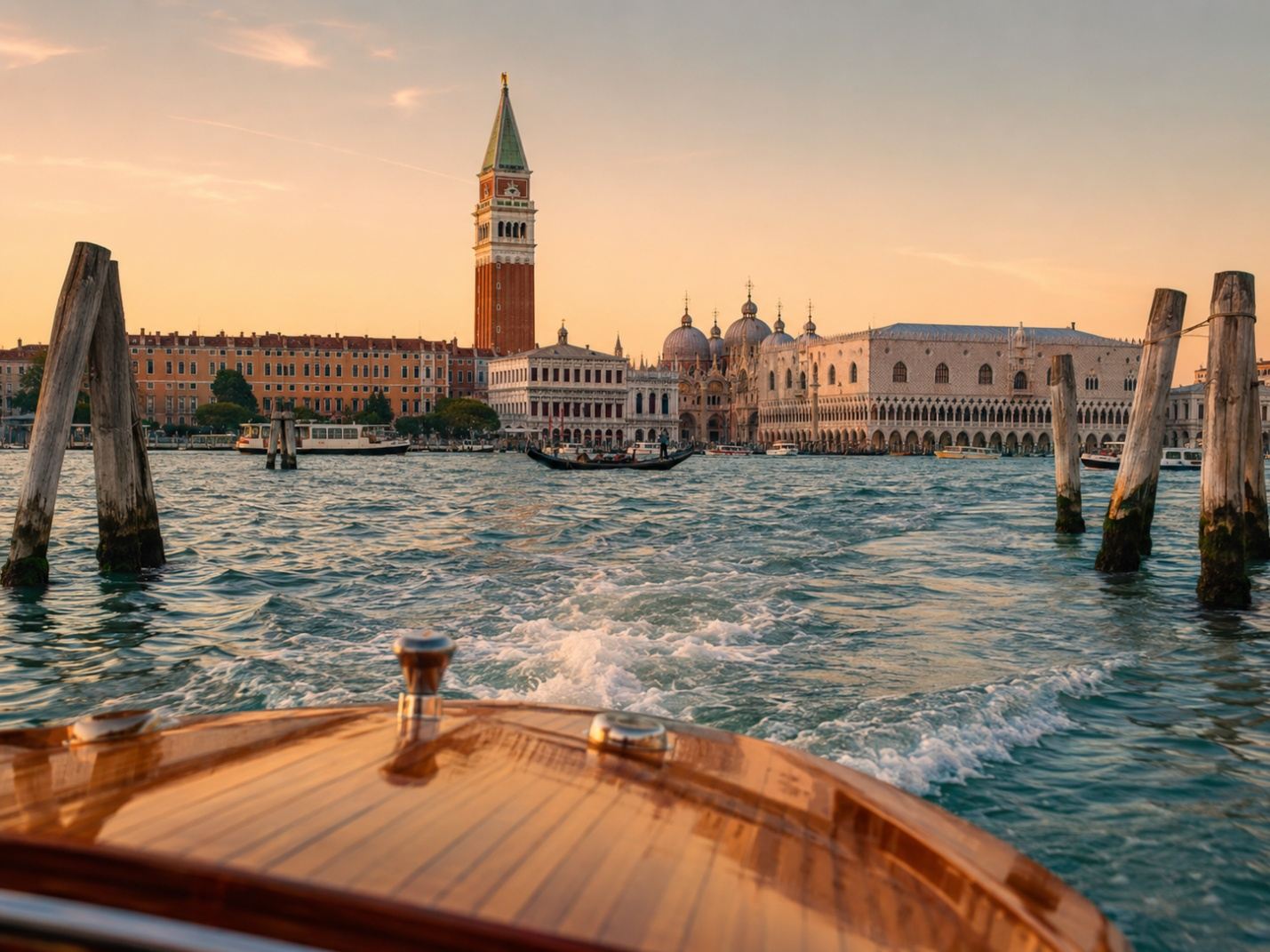
Arriving the only way Venice should be met — by water, at golden hour.
There is no good way to arrive in Venice except by boat, so skip the bus and the people-mover and take a private water taxi from Marco Polo straight across the lagoon to San Marco. The approach past the Lido, with the domes of the Basilica sharpening on the horizon, is genuinely the best twenty minutes of the day, and it deposits you steps from your hotel rather than at the far end of a dozen bridges with luggage.
Once you have dropped bags in San Marco, resist the urge to plan anything. The first afternoon in Venice is for getting deliberately lost in the calli, which is the only way the city ever really makes sense. Work your way north toward the Rialto Bridge, cross it for the view down the Grand Canal, and let the evening end with an ombra and cicchetti standing at a bar counter in San Polo, the way Venetians actually eat before dinner.
Insider Notes
- Book the water taxi in advance and confirm the desk location in the arrivals hall. The walk-up queue on a summer afternoon is long and considerably more expensive.
- Climb the Campanile at golden hour, not midday. The lift line is shortest in the last hour before closing, and the light over the terracotta rooftops is far better.
- The Rialto Market is morning-only and closes entirely on Sundays — save the market itself for a later morning.
- Cross the Grand Canal like a local. The traghetto gondola ferries cost a couple of euros and save a long detour. You stand up for the crossing, which is half the fun.
Where to Eat
- Dinner — a cicchetti crawl through San Polo: All'Arco and Cantina Do Mori are the classics, both standing-room, both closing early. Two or three small plates at each, then move on.
- Alternative — Osteria Bancogiro, on the water past the Rialto market, to sit down with a canal view.
- Gelato — Gelatoteca Suso, two minutes from the Rialto Bridge. Ask for the pistachio — a dull khaki, as real pistachio should be.
Tickets & Costs
| Private water taxi, airport to San Marco (per boat) | €120–140 |
| Campanile di San Marco | €10 |
| Vaporetto single / 24-hour pass | €9.50 / €25 |
| Traghetto crossing | €2 |
Day 2 · Venice
Classic Venice — Basilica, Palace, and the Grand Canal
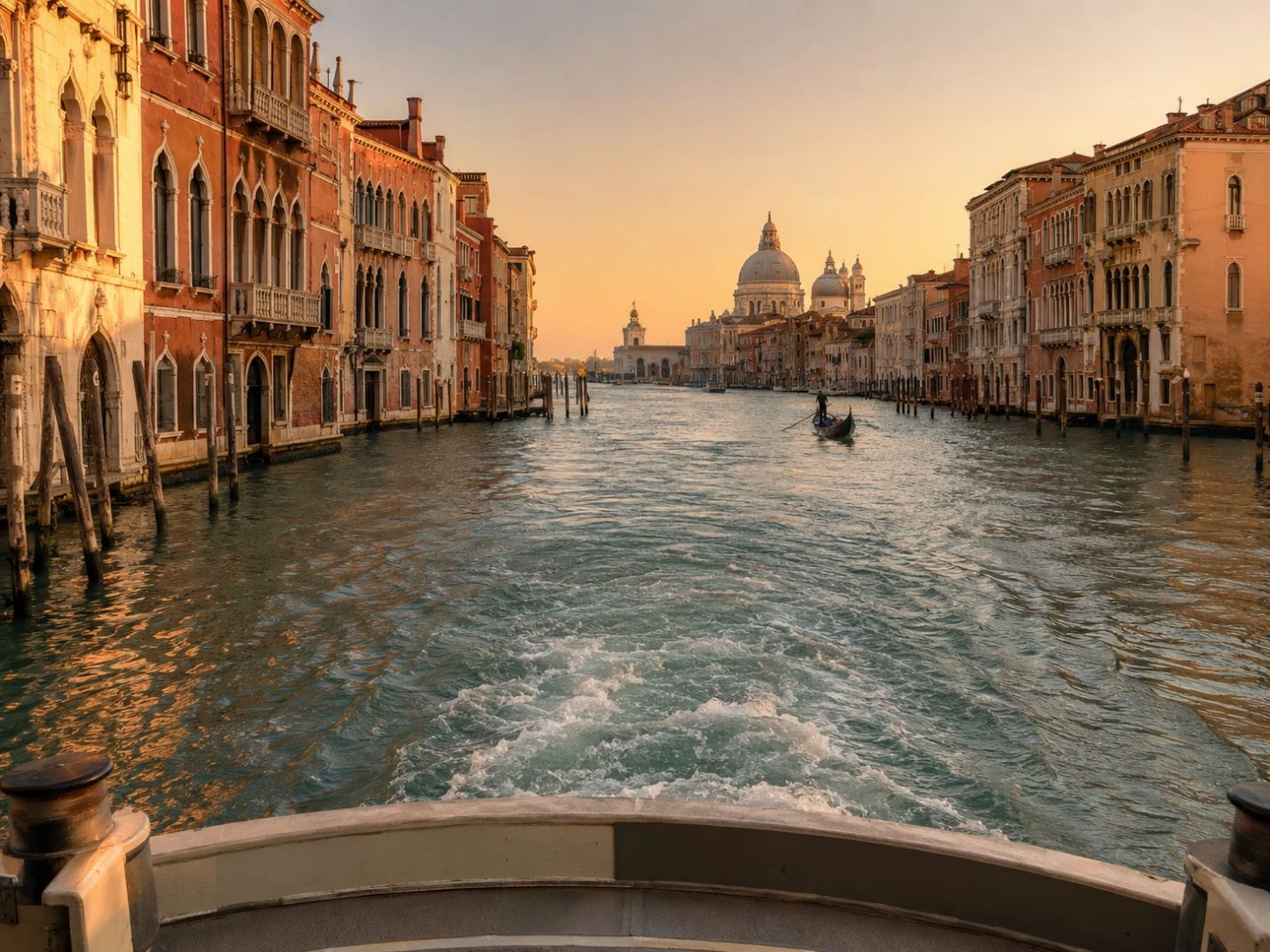
The finest cheap thrill in Europe: the vaporetto up the Grand Canal at golden hour.
This is the day Venice gives you its greatest hits, and the trick is doing them in the right order so you are never fighting a crowd. Start at St Mark's Basilica with a pre-booked skip-the-line entry. The interior is dim, gold-mosaicked, and genuinely staggering when the light catches it, and the fifteen minutes you are allotted is enough because the ceiling is the whole point.
Move next door to the Doge's Palace, where the real reward is not the state rooms but crossing the Bridge of Sighs into the old prisons and understanding, viscerally, how the Republic actually governed itself. Break the afternoon with the Peggy Guggenheim Collection across the water — a small, sun-filled palazzo of Pollocks and Picassos that resets your eyes after all that Byzantine gold — and then close the day by boarding the vaporetto for the slow ride up the Grand Canal, which remains the finest cheap thrill in Europe.
Insider Notes
- Dress code is enforced at the Basilica: shoulders and knees covered, no exceptions. Large bags check free at the nearby Ateneo San Basso — allow ten extra minutes.
- Take vaporetto line 1, not line 2. Line 1 makes every landing and gives you the full palazzo-by-palazzo procession. Stand at the open-air stern in the hour before sunset.
- Book the Doge's Palace Secret Itineraries tour if available — it reaches the attic prisons and Casanova's cell, spaces the general ticket does not cover.
- Eat away from the piazza. San Marco restaurants charge for the address, and cafe tables on the square carry a hefty music surcharge. Ten minutes toward San Polo, quality rises as price falls.
- A golden-hour photoshoot near San Maurizio is well timed at 6pm — soft light, thinned crowds, and the quiet campi west of San Marco make far better backdrops than the piazza.
Where to Eat
- Lunch — Rosa Salva or a standing bacaro near the Frari — quick, unfussy, a fraction of piazza prices.
- Dinner — Antiche Carampane in San Polo, a small, long-established seafood osteria that takes reservations seriously and rewards them. Book several days ahead.
- Gelato — Gelato di Natura on the Strada Nova, or Suso again if you are near the Rialto.
Tickets & Costs
| St Mark's Basilica, skip-the-line entry | €6–8 |
| Pala d'Oro / terrace add-ons | €5 / €7 |
| Doge's Palace (St Mark's Square Museums pass) | €30 |
| Secret Itineraries guided tour | €32 |
| Peggy Guggenheim Collection | €16 |
| Private photoshoot, 2 hours | €350–450 |
Day 3 · Venice
Island Hopping — Murano's Furnaces and Burano's Colors
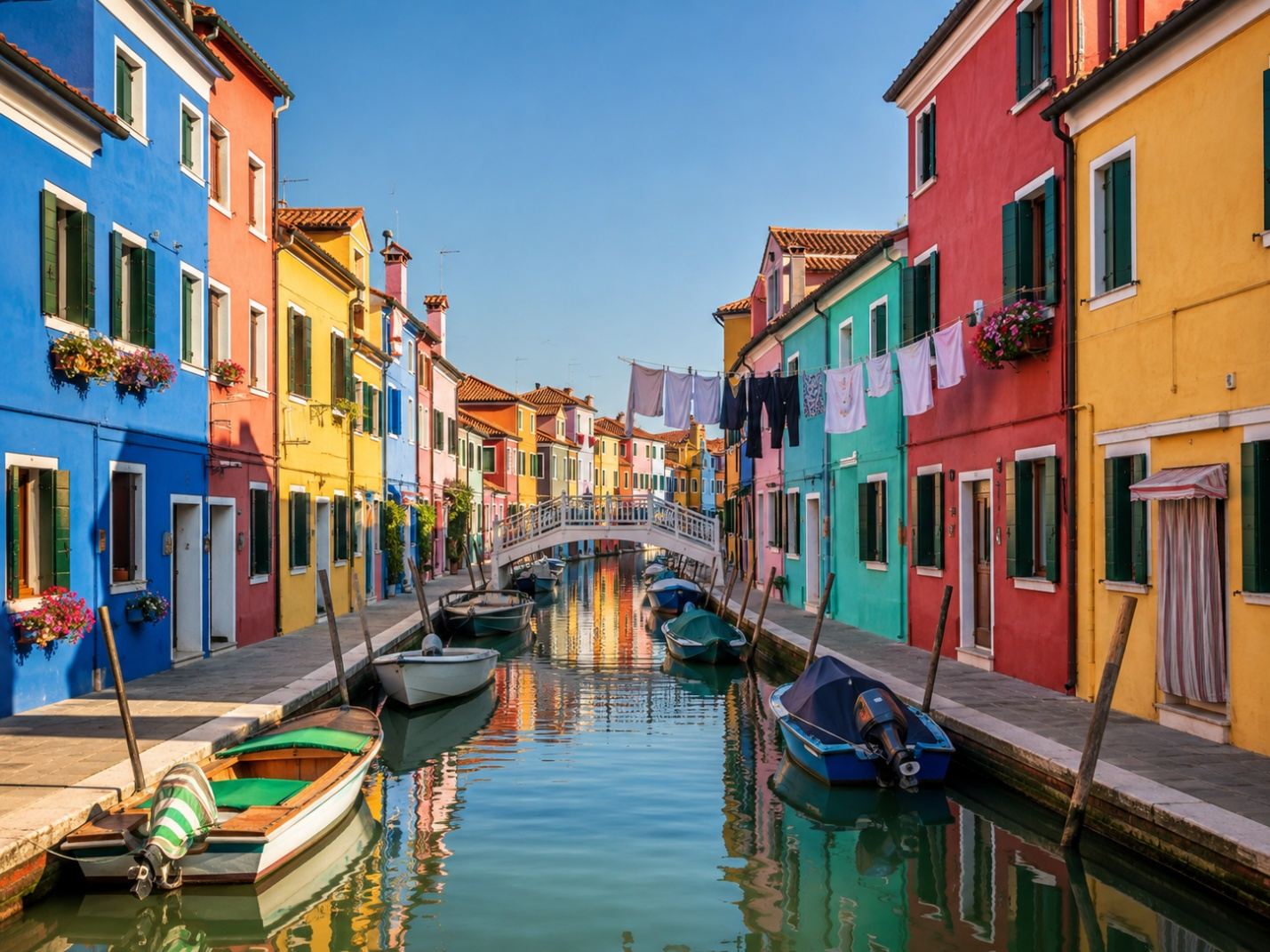
Burano, painted bright so fishermen could find their way home through the lagoon fog.
Give the third day to the lagoon islands, which is where Venice stops performing for visitors and starts feeling like a place people actually live. Take a boat out to Murano first, while the glass furnaces are still running in the morning. Watching a maestro pull a shape out of molten glass in forty seconds is the kind of thing you cannot unsee, and it turns the souvenir you buy afterward into something you actually understand.
Then continue on to Burano for lunch — a fishing village of houses painted in saturated candy colors, said to have been done so the fishermen could pick out their own homes through the lagoon fog. Come back to Venice in the late afternoon for a gondola ride when the light goes soft and the canals empty out, then dinner in San Marco to close the day.
Insider Notes
- Murano in the morning, Burano after lunch. The furnaces wind down as the day goes on, and Burano is at its most photogenic in warm afternoon light.
- Watch for fake Murano glass. Genuine pieces carry the Vetro Artistico Murano trademark seal; buying direct from a furnace on the island is safest.
- Skip the "free glass demonstration" touts near San Marco — they ferry you to a showroom with a hard sell attached. The public boat costs a few euros and leaves you free to walk away.
- Torcello is a ten-minute hop from Burano — almost uninhabited, with an 11th-century basilica holding some of the finest Byzantine mosaics in Italy. Very few day-trippers make it.
- Gondola rates are set by the city, not the gondolier, and the evening rate after 7pm is higher. The fare covers the boat — up to five people share it. The quiet ride through the back canals beats the singing-gondolier arrangement anyway.
Where to Eat
- Lunch — Trattoria Al Gatto Nero on Burano, the island's benchmark for risotto de gò, made with lagoon goby fish. Reserve ahead.
- Local sweet — bussolà and esse butter cookies from any Burano bakery, traditionally dunked in dessert wine.
- Dinner — back in San Marco: Al Covo or Trattoria da Fiore for a proper sit-down evening.
- Gelato — Gelateria Nico on the Zattere, for the gianduiotto: chocolate-hazelnut ice cream drowned in whipped cream. A Venetian institution.
Tickets & Costs
| Vaporetto 24-hour / 48-hour pass | €25 / €35 |
| Murano glass furnace demonstration | Free–€10 |
| Torcello, Santa Maria Assunta basilica | €5 |
| Gondola, 30 min, daytime (up to 5 people) | €90 |
| Gondola, 30 min, after 7pm | €110 |
Day 4 · Florence
Venice to Florence — Arrival Under the Dome
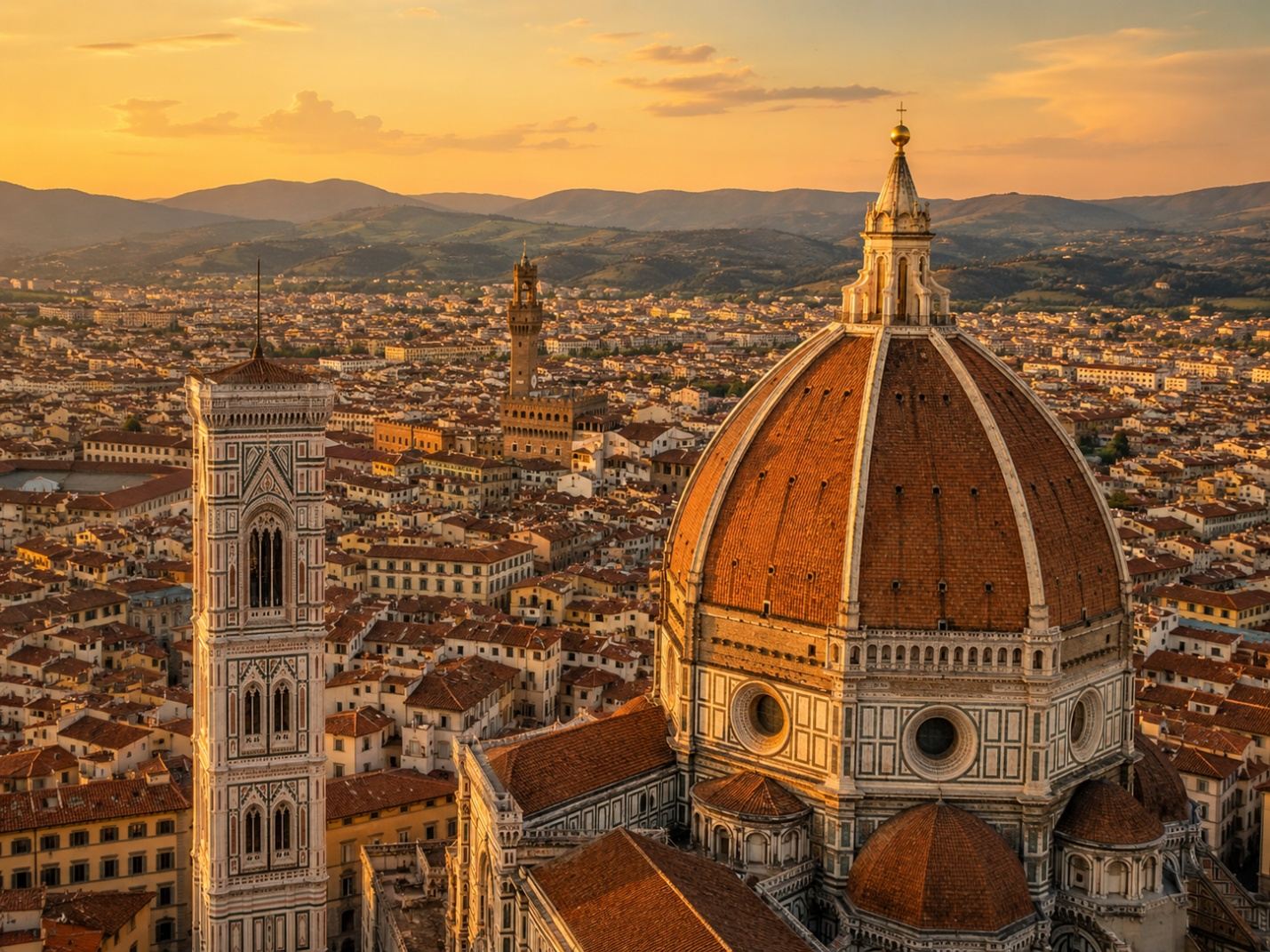
Brunelleschi's dome — a structure nobody in 1420 knew how to build, still holding the skyline.
Trade the lagoon for Tuscany on a late-morning train, which covers the distance in a little over two hours and hands you Florence with the whole afternoon still intact. Check into your hotel on Piazza Santa Maria Novella — a location worth appreciating, since almost everything on the day's list is a ten-minute walk from your door — and then go straight to the Duomo.
Climb Brunelleschi's dome while your legs are still fresh. The ascent is 463 steps up a passage that runs between the inner and outer shells of the dome, close enough to touch the brickwork of a structure nobody in 1420 knew how to build, and the panorama across the rooftops at the top is the moment Florence properly begins. Duck into the Baptistery afterward for the mosaic ceiling and the bronze doors Michelangelo is said to have called the Gates of Paradise, then walk over to Santa Croce — Florence's Westminster Abbey, holding Michelangelo, Galileo, Rossini, and Machiavelli, plus a leather school in back operating since the 1950s.
Insider Notes
- The platform at Venezia Santa Lucia is announced only about fifteen minutes before departure. Stay near the board.
- The dome climb requires a separate timed reservation and sells out days ahead in June — it is not covered by simply holding a Duomo pass. No large bags, no elevator, and the final stretch is a steep curved staircase.
- Anyone claustrophobic should take Giotto's Campanile instead: fewer steps, open air, and arguably the better view — because the dome itself is in it.
- The Baptistery doors you see outside are replicas. The restored originals are in the Museo dell'Opera del Duomo, displayed at eye level and far more impressive up close.
- Santa Croce stays open through lunch when much of Florence closes — the right thing for the early-afternoon dead zone.
- Piazzale Michelangelo is the best sunset move — twenty minutes uphill from the Ponte Vecchio, with the classic view of the city, dome centered.
Where to Eat
- Lunch — on the train, or a panino at All'Antico Vinaio near Santa Croce: famous, enormous, worth the queue if it is moving.
- Dinner — Trattoria Sostanza, an unchanged 1869 institution known for butter chicken and an artichoke tart. Communal tables, two seatings, cash preferred, reservations essential.
- Alternative — Il Latini, boisterous and family-style, for first-night-in-Florence atmosphere.
- Gelato — Gelateria dei Neri, a short walk from Santa Croce and consistently among the best in the center.
Tickets & Costs
| Train, Venice to Florence (Frecciargento) | €25–55 |
| Brunelleschi Pass (dome, baptistery, campanile, museum, crypt) | €30 |
| Santa Croce | €8 |
| Taxi, station to hotel | €10–15 |
Day 5 · Florence
David, Gelato, and the Oltrarno
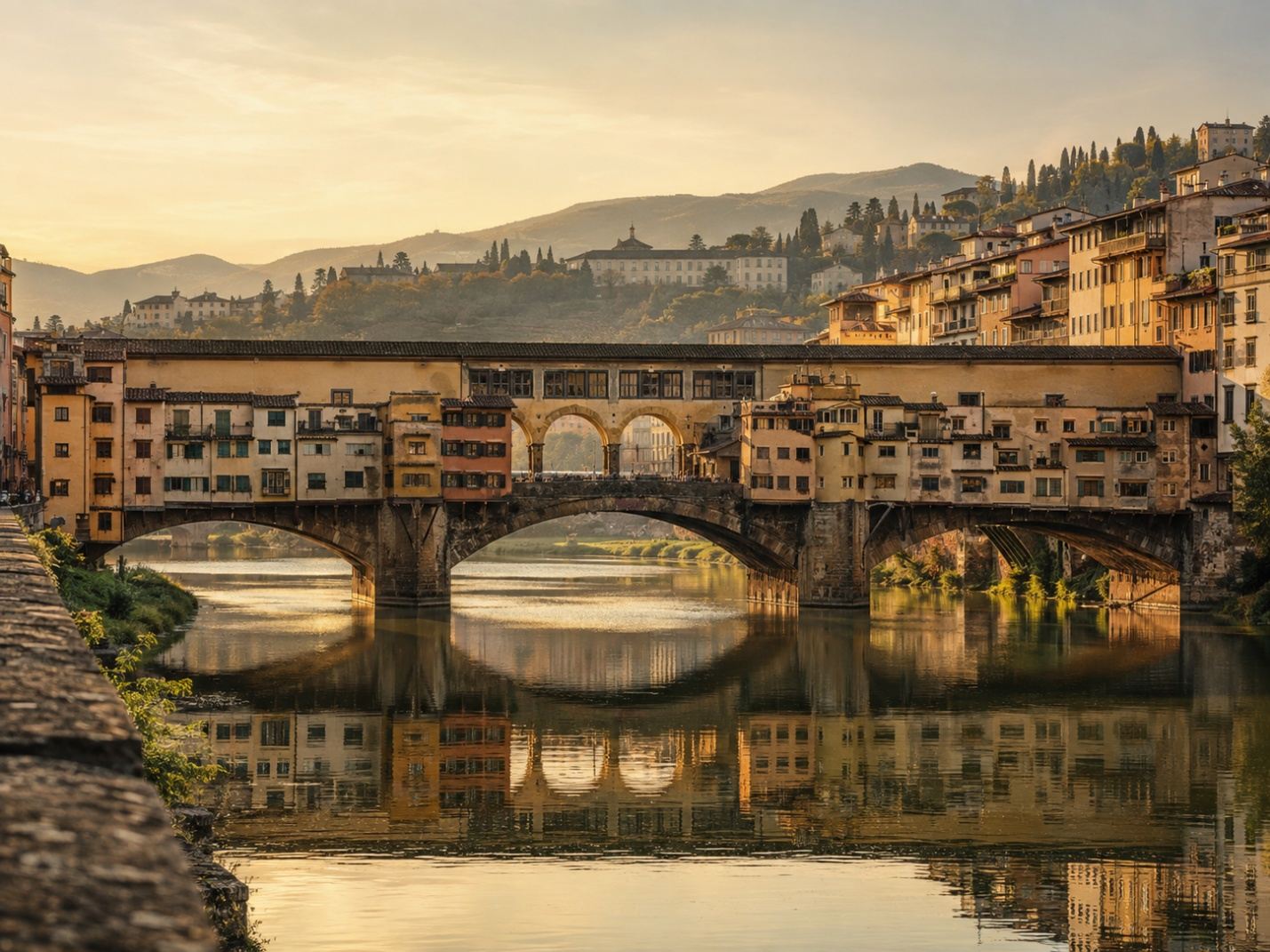
The last bridge in Florence the Germans left standing, still carrying its goldsmiths.
The second Florence day is built around one appointment and a lot of unstructured wandering, which is the right ratio for this city. Spend the morning on foot in the center — the leather market at San Lorenzo, the Mercato Centrale for a lampredotto panino if you are brave, the small streets between the Duomo and the Arno that reward having no particular plan.
Your Accademia entry is in the early afternoon, and the reason to go is not really the David everyone photographs but the walk toward him: Michelangelo's unfinished Prisoners line the hall on the approach, half-carved figures still trapped in raw marble, and seeing them first is what makes the finished statue at the end of the corridor land the way it should. Afterward, stop at Vivoli for gelato, cross the Ponte Vecchio into the Oltrarno, and give the rest of the afternoon to the Pitti Palace and Boboli Gardens. The artisans' quarter on that side of the river is where Florence still feels like a working city rather than a museum.
Insider Notes
- Arrive at the Accademia fifteen minutes before your slot, not more — and check you are in the reserved-ticket line, which queues at a different door.
- The Accademia is smaller than people expect. Ninety minutes covers it comfortably, leaving the late afternoon genuinely free.
- Vivoli has no cones, only cups, by house tradition, and is cash-preferred. It sits on a side street in Santa Croce rather than anywhere obvious.
- A quick test for good gelato anywhere in Italy: if the pistachio is bright green and the banana is yellow, walk away.
- Pitti and Boboli are separate tickets; the combined pass is better value for both. Boboli is a hillside, steeper and larger than it looks — allow ninety minutes and proper shoes.
- Cross the Ponte Vecchio early or late — midday is shoulder-to-shoulder. Above the shops runs the Vasari Corridor, the Medici's private elevated passage built so they never had to walk among their own citizens.
Where to Eat
- Lunch — Mercato Centrale upstairs: a covered food hall good for grazing without committing an hour.
- Dinner — Trattoria Cammillo in the Oltrarno, a long-running family place both serious and warm. Book in the morning.
- Alternative — Il Santo Bevitore, near Santo Spirito, for a more modern kitchen and a strong wine list.
- Gelato — Vivoli, in Santa Croce — the oldest in the city, and still worth the detour. Cups only.
Tickets & Costs
| Accademia Gallery (David), with booking fee | €16 + €4 |
| Uffizi Gallery, high season, if added | €25 |
| Pitti Palace | €16 |
| Boboli Gardens | €10 |
| PassePartout 5-day combined pass | €38 |
Day 6 · Cortona
Into the Hills — Florence to Cortona
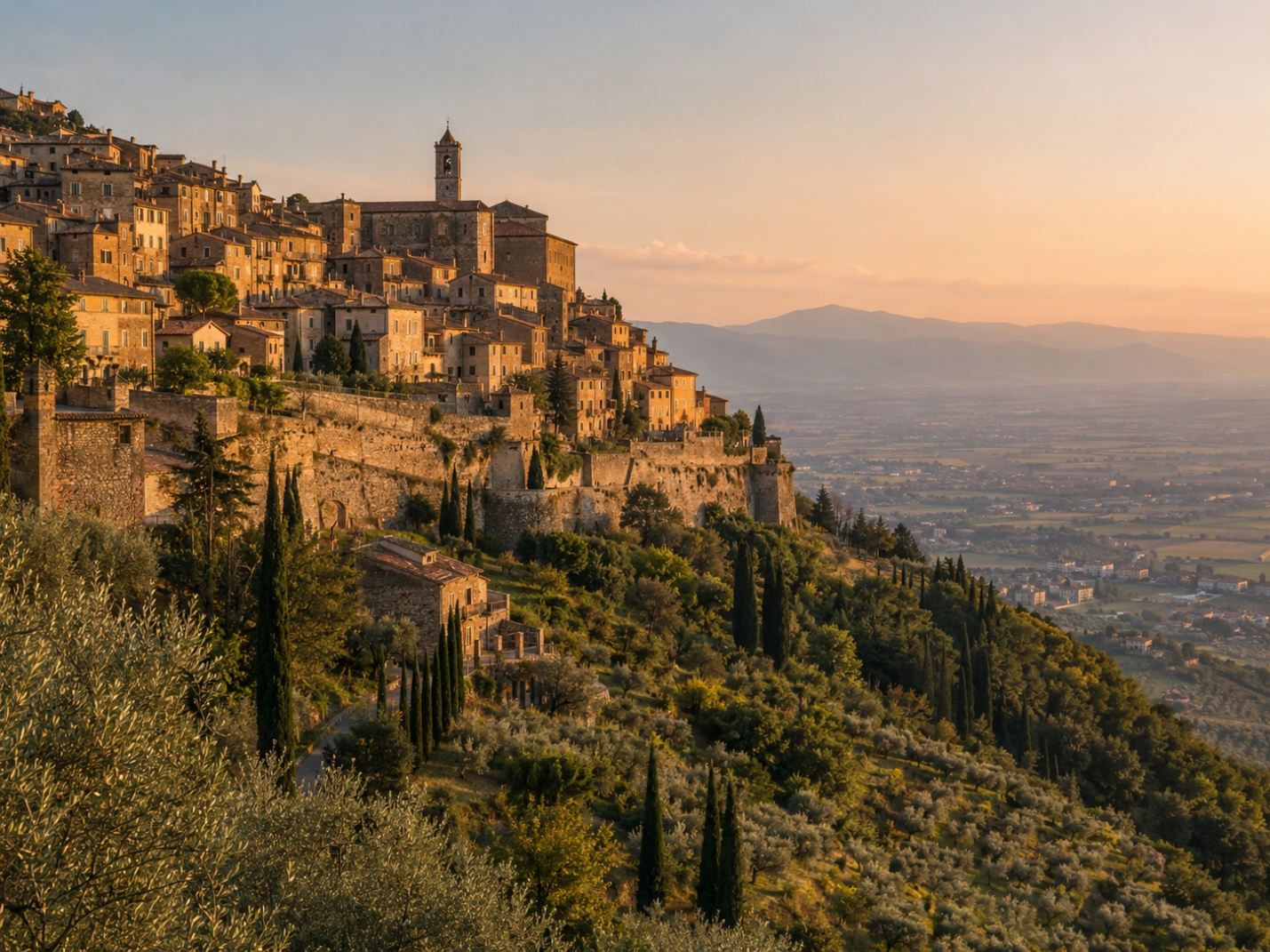
Cortona, holding its hill behind Etruscan walls for two and a half thousand years.
This is the day the trip changes pace, and the transition is the point. Spend a slow morning in Florence — a last walk, a proper lunch, no agenda — then collect the rental car in the early afternoon and drive south. The A1 gets you to Cortona in well under two hours, and the arrival is genuinely cinematic: the road climbs off the valley floor through olive terraces until an Etruscan hill town appears above you, stone walls two and a half thousand years old holding up a village of steep lanes and sudden views.
Check in, drop the bags, and give the evening to Cortona itself — a passeggiata up Via Nazionale, an aperitivo in Piazza della Repubblica as the light goes long over the Val di Chiana, and dinner without having queued for anything all day.
Insider Notes
- Pick the car up with a full tank of daylight. Italian rental desks are slow, and the approach to Cortona is steep, narrow, and less charming in the dark.
- ZTL is the thing to understand before you drive anywhere in Tuscany. Historic centers are camera-monitored restricted-traffic zones; fines arrive by mail months later, one per entry. Park in the lots outside Cortona's walls and walk in.
- Ask your hotel in advance to register your plate for a temporary ZTL permit for the check-in run — most small hotels can, but they need the number ahead of time.
- Confirm the car is automatic when you book. Automatics are the minority in Italy, cost more, and sell out.
- Cortona is vertical. Pack light for the walk up, and wear shoes with grip — the lanes are worn stone, slick when damp.
- Go up to the Basilica di Santa Margherita and the Medici fortress above it for the view over Lake Trasimeno. Twenty minutes uphill, and the best thing in town at sunset.
Where to Eat
- Lunch — a last Florentine meal: Trattoria Mario near San Lorenzo. Lunch only, cash only, shared tables — the bistecca is the reason to go.
- Dinner — La Bucaccia in Cortona, in a medieval building with a cheese cellar downstairs, known for house-made pici. Reserve ahead.
- Alternative — Osteria del Teatro, more formal, in a beautifully theatrical dining room.
- Gelato — Gelateria Snoopy on Piazza Signorelli — unglamorous name, excellent product, terrace over the piazza.
Tickets & Costs
| Car rental, mid-size automatic, per day | €60–90 |
| Fuel and tolls, Florence to Cortona | €25–30 |
| MAEC, Museum of the Etruscan Academy | €10 |
| Parking outside the walls, per hour | €1–2 |
Day 7 · Cortona
Siena and San Gimignano — A Day in the Tuscan Countryside
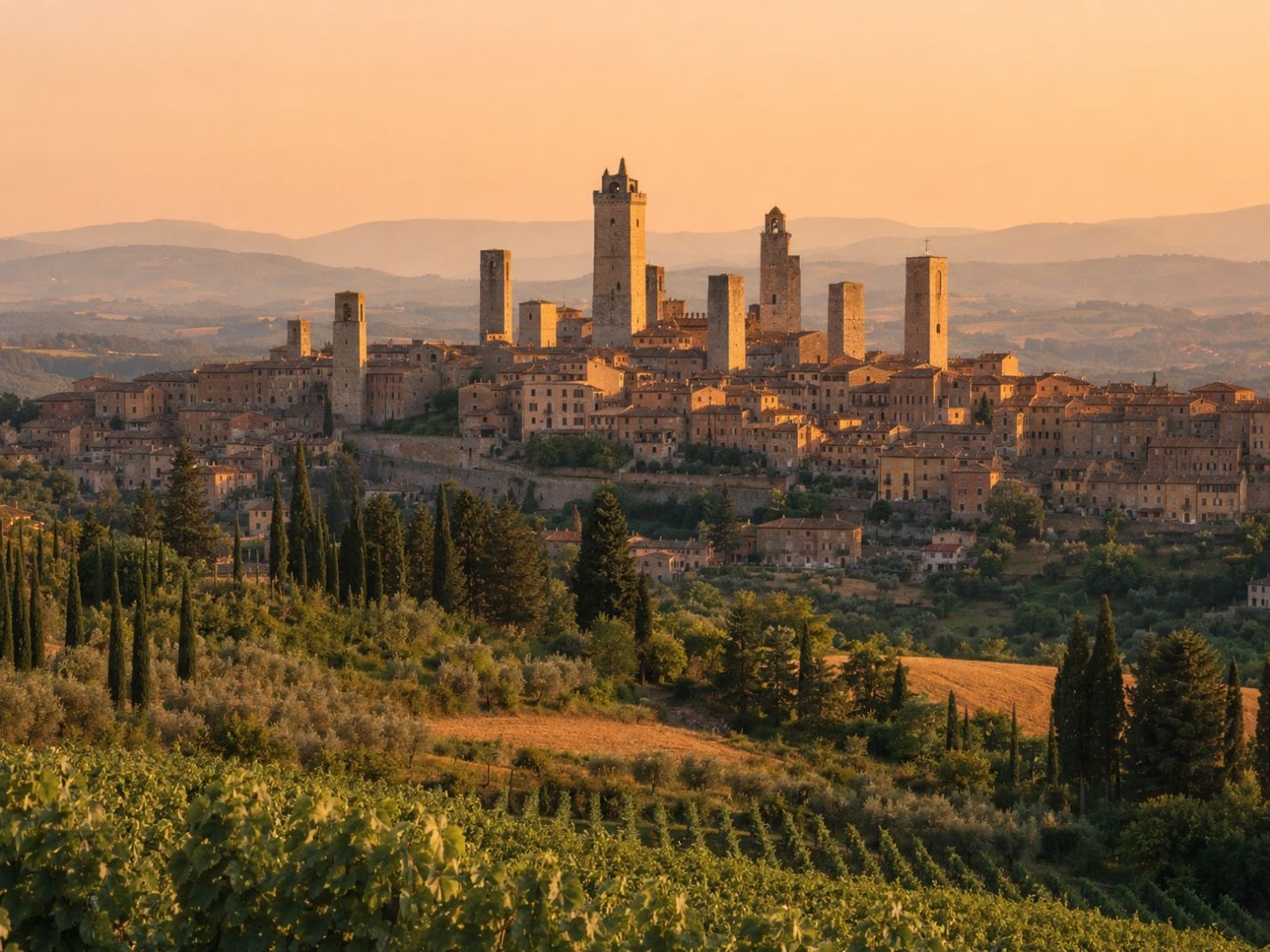
Fourteen towers left of seventy, built by families who competed in height.
With Cortona as a base, this is the day the car earns its keep: a loop west through two of the most distinctive towns in Tuscany, with the drive between them as good as either destination. Siena comes first, about an hour away, and it is a genuinely medieval city rather than a Renaissance one — the shell-shaped Piazza del Campo slopes down to the Palazzo Pubblico like an amphitheatre, and the striped black-and-white Duomo has an inlaid marble floor that is among the most extraordinary things in Italy.
Have lunch there, then drive on to San Gimignano, where fourteen stone tower-houses still stand out of an original seventy-odd, built by rival families competing on sheer height. The skyline is why people call it the medieval Manhattan, and it is best seen in late afternoon once the coach tours have gone. Dinner in San Gimignano, then the drive back to Cortona under the dark — a long day, but a rich one.
Insider Notes
- Leave early. Roughly three and a half hours of driving plus two towns — breakfast at eight and on the road by nine makes the difference between a full day and a rushed one.
- Both towns are ZTLs with car parks outside the walls. In Siena, aim for the San Francesco or Il Campo garages and take the escalators up. In San Gimignano, Parcheggio Giubileo or Bagnaia.
- The Duomo's marble floor is usually kept covered and only fully uncovered in late summer and autumn. The Piccolomini Library off the nave is unmissable regardless — frescoes so vivid they look painted last year.
- In the Campo, sit on the bricks rather than at a cafe table. The square is designed to be sat in, everyone does it, and the view costs nothing.
- San Gimignano's specialty is Vernaccia, the crisp white grown on the slopes below town and the first Italian wine to receive DOC status. A glass at sunset with the towers above you is the correct way to end the day.
- Drive back before you are too tired. The last stretch to Cortona is winding and unlit — coffee before you go is not optional.
Where to Eat
- Lunch — Osteria Le Logge in Siena, just off the Campo: a converted pharmacy with original cabinetry, consistently good for decades. Book ahead.
- Alternative — Trattoria Papei, behind the Palazzo Pubblico, simpler and cheaper.
- Dinner — Cum Quibus in San Gimignano for a refined evening, or Locanda Sant'Agostino for something more relaxed.
- Gelato — Gelateria Dondoli on Piazza della Cisterna — a former world gelato champion. The saffron-and-pine-nut is the one to try.
Tickets & Costs
| Siena OPA SI Pass (Duomo complex, library, crypt) | €15–20 |
| Torre del Mangia climb | €10 |
| Palazzo Pubblico civic museum | €10 |
| San Gimignano Torre Grossa & civic museums | €9–13 |
| Fuel, tolls, parking for the day | €30–40 |
Day 8 · Orvieto
Montepulciano to Orvieto — Wine, Stone, and a Cliff-Top City
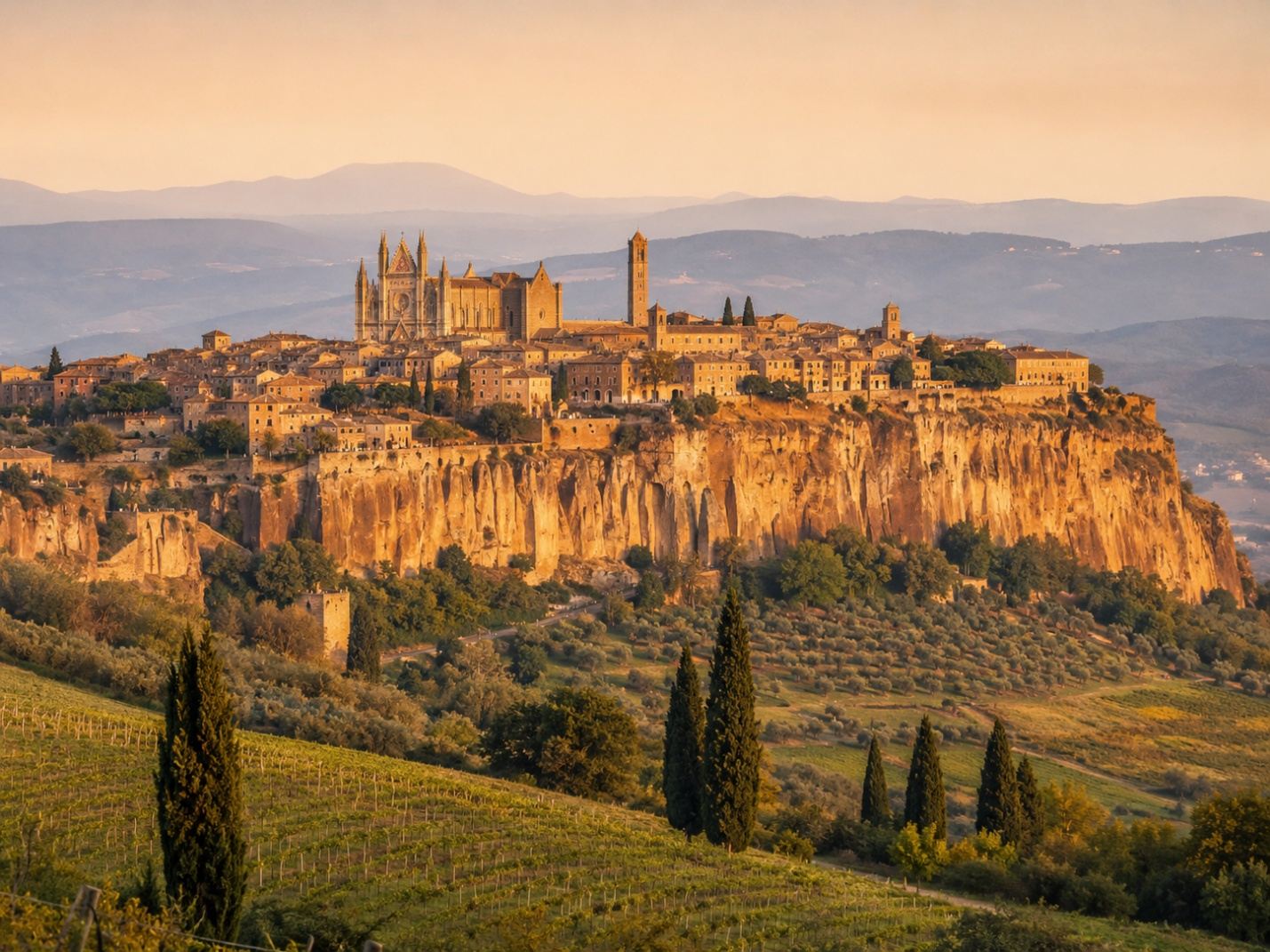
Orvieto, built on a plateau of volcanic rock and honeycombed with Etruscan tunnels beneath.
Today is a short, indulgent drive rather than a marathon, and it is a good one. Head first to Montepulciano, forty minutes south — a Renaissance hill town stacked along a single spine of ridge, where the main street climbs steadily to a piazza with views over two valleys, and where the real attraction is underground: the historic cantine beneath the palazzi, cellars cut into tufa rock where Vino Nobile ages in enormous oak barrels.
Have lunch there, taste something, then continue an hour south to Orvieto, a city that sits on a flat plateau of volcanic tufa rising sheer out of the plain. The approach is startling, and the cathedral facade waiting at the top is one of the great pieces of Gothic showmanship in Italy — a wall of gold mosaic and carved marble that seems to be lit from within at sunset. Check in by late afternoon and let the evening be quiet: dinner, a glass of Orvieto Classico, and nothing else asked of you.
Insider Notes
- The Montepulciano cantine are free to walk into and most offer tastings for a small fee. Contucci and De' Ricci both run cellars beneath their palazzi — the descent through carved tufa passages is worth it even if you do not drink.
- Do not confuse Vino Nobile di Montepulciano with Montepulciano d'Abruzzo — different grape, different region, several hours away. A common and disappointing souvenir mistake.
- Montepulciano's main street is one long uphill — about a hundred metres of elevation. Park at the bottom and climb, or use the lots near the top gate.
- In Orvieto, park at the base and take the funicular up. It runs from beside the train station to the edge of the old town and saves you the ZTL and a set of very tight switchbacks.
- See the Duomo facade in the last hour of light. The mosaics catch the low western sun and genuinely blaze. Inside, the Cappella di San Brizio holds Signorelli's Last Judgment — which Michelangelo studied before painting the Sistine Chapel.
- Orvieto is honeycombed underneath. Etruscan tunnels, wells, and caves run beneath the whole plateau — the Orvieto Underground tour takes you into them.
Where to Eat
- Lunch — Osteria Acquacheta in Montepulciano, where the bistecca is cut and weighed at your table and the house wine arrives in a jug. Two seatings, reservations essential.
- Dinner — Trattoria del Moro Aronne in Orvieto, family-run for three generations, for umbricelli pasta and local truffle.
- Alternative — dinner at your countryside hotel, the more restful choice after a driving day.
- Gelato — Pasqualetti, beside the Orvieto Duomo, with tables in the shadow of the facade. The fig and the hazelnut are both excellent.
Tickets & Costs
| Montepulciano cantina tasting | €10–25 |
| Orvieto Duomo & Cappella di San Brizio | €5 |
| Orvieto Underground guided tour | €8 |
| Pozzo di San Patrizio (St Patrick's Well) | €5 |
| Funicular, each way | €1.30 |
Day 9 · Amalfi Coast
South to the Coast — Arrival at a Cliffside Monastery
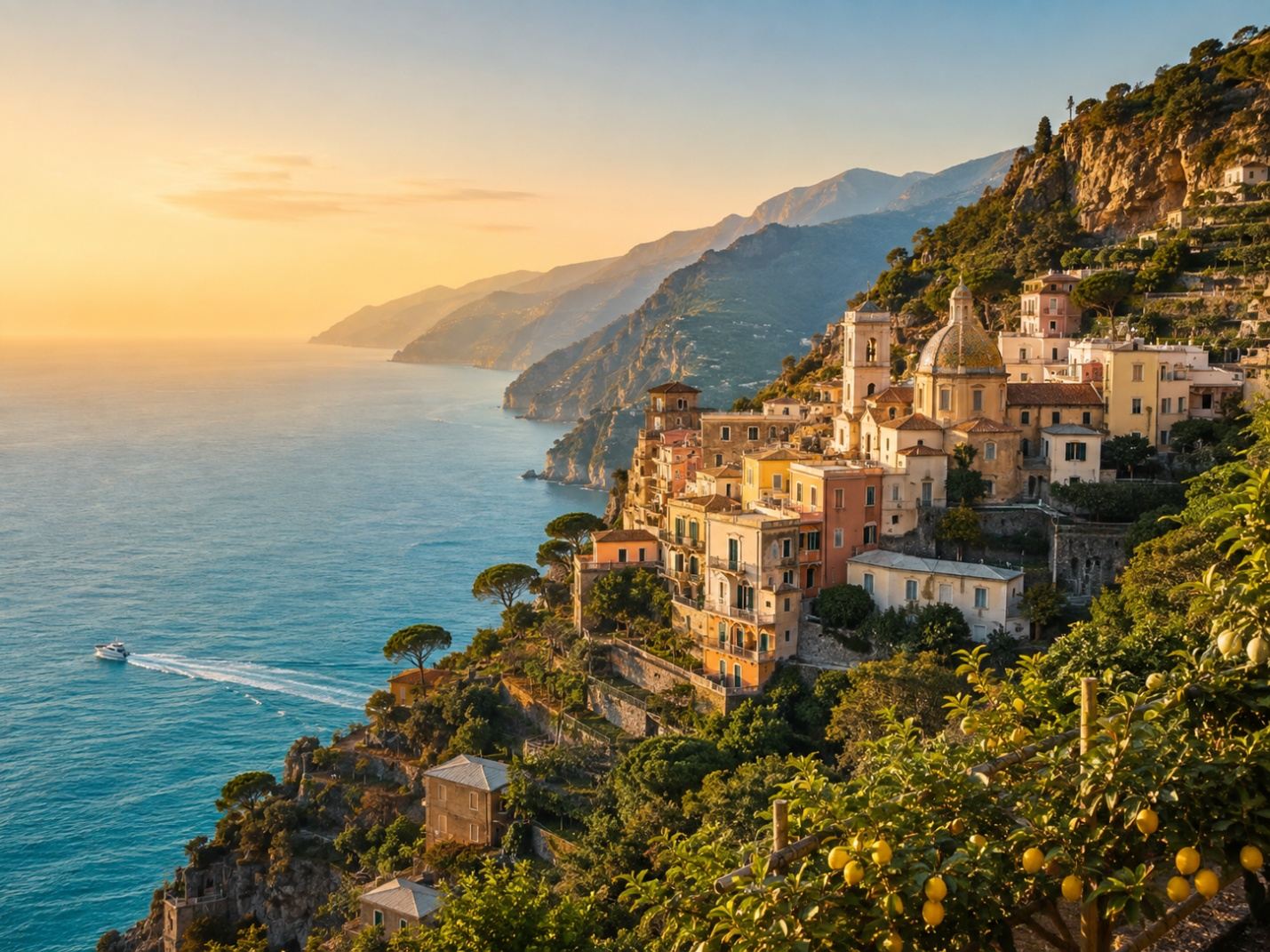
Five hours of driving, and then the coast simply appears below you.
Today is the long haul, and the payoff at the end justifies every hour of it. Leave Orvieto mid-morning for the drive south past Rome and Naples, aiming to reach Amalfi by mid-afternoon. The last stretch is the famous coastal road, cut into sheer cliff above the sea, and it is slow, narrow, spectacular, and not to be rushed.
Check into the Anantara Convento di Amalfi Grand Hotel, a thirteenth-century Capuchin monastery set on a ledge high above the town, where the monks' cells are now guest rooms and the old cloister's Arab-Norman arches open onto a hanging terrace with nothing between you and the Tyrrhenian. Then do nothing at all: the terrace, the lemon grove, and a drink as the light goes are the reason you drove five hours. If you want one thing to see before dinner, the Grotta dello Smeraldo is ten minutes west — a sea cave where light refracts up through the water and turns the whole cavern a strange luminous green.
Insider Notes
- Break the drive at Naples for pizza if the timing works, but budget generously for traffic. Leaving by ten is the difference between arriving relaxed and arriving in the dark.
- The Amalfi Drive is not the place to learn Italian driving. One lane each way, blind bends, buses that take both lanes on corners. Local etiquette is a light horn tap before a blind curve — use it, and pull your mirrors in when passing a coach.
- Arrange parking and arrival with the hotel in advance. The Convento sits well above the road with lift access, and space on this coast is severely limited.
- Ask for a cloister-side or sea-facing room when you confirm — the converted monastic cells vary considerably, and a note on the reservation costs nothing.
- The Grotta dello Smeraldo closes in rough seas and by late afternoon. Late morning gives the best light.
- Book dinner tonight rather than hoping — June fills kitchens early, and everything here is vertical, including the walk down into Amalfi and back up.
Where to Eat
- Lunch en route — Naples, if the timing works: Da Michele or Sorbillo for the definitive Neapolitan pizza. Both cheap, both with a queue.
- Dinner — Da Gemma in Amalfi, a family institution since 1872, on a terrace above the main street. Reserve well ahead in June.
- Alternative — the hotel's cliffside restaurant, which spares you the walk back up and is a memorable first night in its own right.
- Gelato & pastry — Pasticceria Pansa on the cathedral square, open since 1830. The delizia al limone and the candied citrus peel are both worth the stop.
Tickets & Costs
| Fuel and tolls, Orvieto to Amalfi | €60–75 |
| Grotta dello Smeraldo (entry + rowboat) | €10 + €5 |
| Amalfi Duomo & Cloister of Paradise | €3 |
| Hotel parking, per night | €25–40 |
Day 10 · Amalfi Coast
West Along the Coast — Praiano and Positano
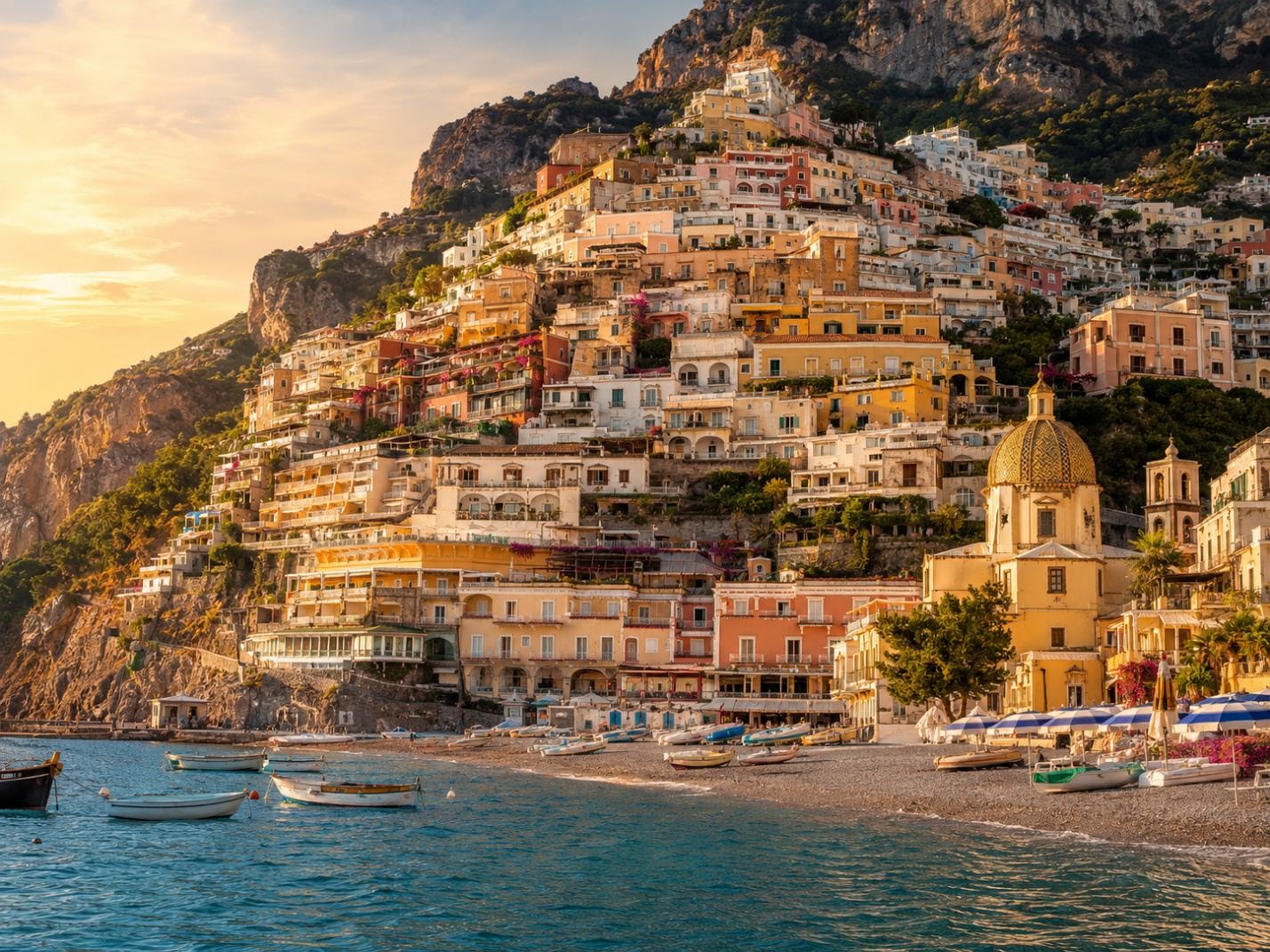
Positano from the water — the view the town was built to be seen from.
Today runs west along the most photogenic stretch of the coast, taken in the order that suits the light and the crowds. Start with Praiano, twenty minutes along the drive — an unglamorous working village strung across the cliffs where people actually live, with the same views as its famous neighbour, a fraction of the visitors, and lunch at half the price.
Then continue to Positano for the afternoon: an amphitheatre of pink, peach, and ochre houses tumbling down a near-vertical cliff to a small grey beach, with the majolica dome of Santa Maria Assunta at the bottom. It is genuinely as beautiful as advertised, provided you accept that everything in it is a staircase. Explore the lanes and boutiques once the day-trippers thin in the late afternoon, then stay for dinner and drinks as the town lights come on down the cliff face.
Insider Notes
- Do not drive into Positano. Parking is scarce and expensive, and the town is a one-way loop that will swallow forty minutes. From Amalfi, the ferry is the pleasant option — arriving by sea is the best view of the town you will get — and the SITA bus is the practical one.
- Positano is one-way on foot too. Via Cristoforo Colombo down to the beach; the way back up is stairs or the small orange local bus. Wear real shoes, not the sandals the photos suggest.
- Fornillo beach, a ten-minute walk west along the cliff path, is quieter and considerably more relaxed than the main Spiaggia Grande.
- Go inside the church for the Byzantine Black Madonna. Beneath the piazza is an excavated Roman villa — a small site almost nobody queues for.
- Praiano gets the last light. This stretch faces west — the terrace at San Gennaro church holds the sun after Positano has fallen into cliff shadow.
- Check the last ferry back to Amalfi before you settle in. Service ends earlier than dinner does; the alternative is a late bus or an expensive taxi.
Where to Eat
- Lunch — Il Pirata in Praiano, built into the rock at the water's edge. Simple seafood, honest prices, one of the best-value views on the coast.
- Dinner — La Cambusa in Positano, on the terrace above the beach — long-established and reliable for seafood and lemon-heavy pastas.
- Aperitivo — Franco's Bar, next to Le Sirenuse, for the coast's most photographed sunset drink. No reservations; arrive early.
- Gelato & pastry — La Zagara in Positano, a garden pastry shop under lemon trees, for granita and lemon delight.
Tickets & Costs
| Ferry, Amalfi to Positano, each way | €10–13 |
| SITA bus, single | €2–3 |
| Sun lounger & umbrella, Spiaggia Grande | €25–40/day |
| Santa Maria Assunta & Roman villa (MAR) | €10 |
Day 11 · Amalfi Coast
Ravello and Minori — The Coast from Above
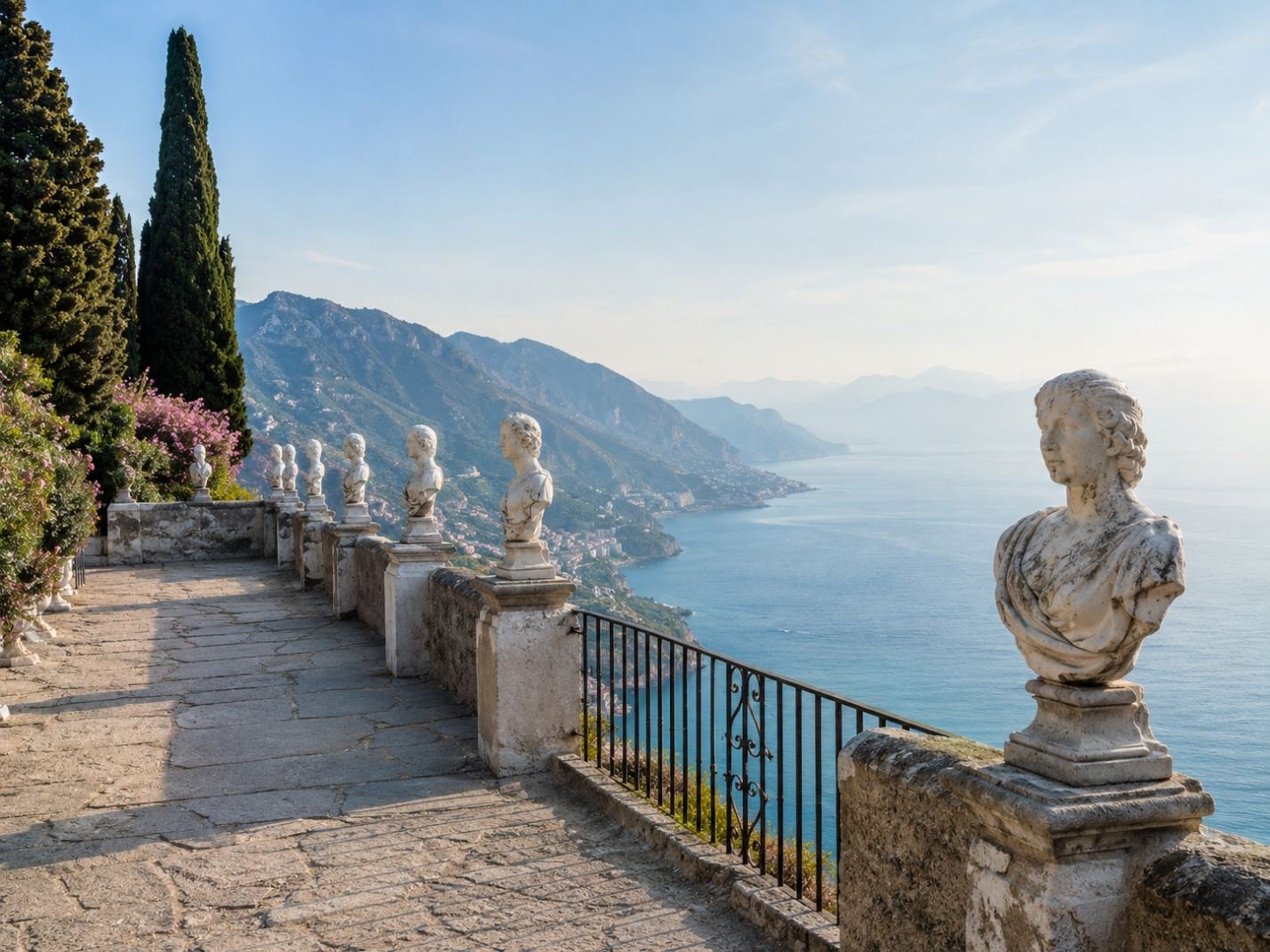
The Terrace of the Infinite, where the balustrade simply ends in open sky.
Yesterday was the coast at sea level; today is the coast from a thousand feet up, and the contrast is the reason to do both. Ravello sits directly above Amalfi — fifteen minutes by car up a series of switchbacks — and it is the quiet, cultured counterweight to Positano: no beach, no boutiques worth queuing for, just two extraordinary garden villas perched on the cliff edge. Villa Rufolo's terrace, which Wagner said gave him the enchanted garden of Parsifal, and Villa Cimbrone's Terrace of the Infinite, a stone balustrade lined with marble busts that simply ends in open sky and sea.
Drop down to Minori on the way back for lunch — a modest seaside town almost entirely free of visitors, with a first-century Roman villa beside the beach and a pastry tradition locals take seriously — then return to Amalfi in the late afternoon to see the cathedral and its striped Arab-Norman facade properly before dinner.
Insider Notes
- Ravello is best in the morning. Coach groups arrive around eleven, and the gardens are at their most peaceful before that.
- Cimbrone and Rufolo need separate tickets. If you only have time for one: Cimbrone has the better view, Rufolo the better gardens — Cimbrone wins for most people.
- The Ravello Festival runs through the summer, with concerts staged on the Villa Rufolo terrace with the sea as backdrop. If your dates catch one, book well ahead — it is among the most memorable evenings on this coast.
- Minori's Villa Romana is free and takes twenty minutes, with intact frescoes. Almost nobody stops here, which is precisely the appeal.
- The SITA bus from Amalfi's waterfront removes the parking problem entirely — Ravello's lots fill by mid-morning.
- Do not skip the Amalfi Duomo itself. The staircase up from the piazza is the town's signature image, and the Cloister of Paradise is a genuinely beautiful piece of thirteenth-century Arab-Norman architecture most day-trippers walk past.
Where to Eat
- Lunch — Sal De Riso in Minori — the pastry chef who made the coast's desserts famous. Ask for the delizia al limone, invented in this town.
- Alternative lunch — Cumpa' Cosimo in Ravello, run by the same family for generations, known for its sampler plate of house-made pastas.
- Dinner — Marina Grande in Amalfi, directly on the beach, with your feet nearly in the sand.
- Gelato — Gelateria Calce in Ravello, small and excellent, with a fig-and-ricotta worth ordering.
Tickets & Costs
| SITA bus, Amalfi to Ravello | €1.50–2.50 |
| Villa Rufolo | €7 |
| Villa Cimbrone | €10 |
| Villa Romana, Minori | Free |
| Ravello Festival concert, if dates align | €30–120 |
Day 12 · Capri
Capri — The Blue Grotto and Monte Solaro
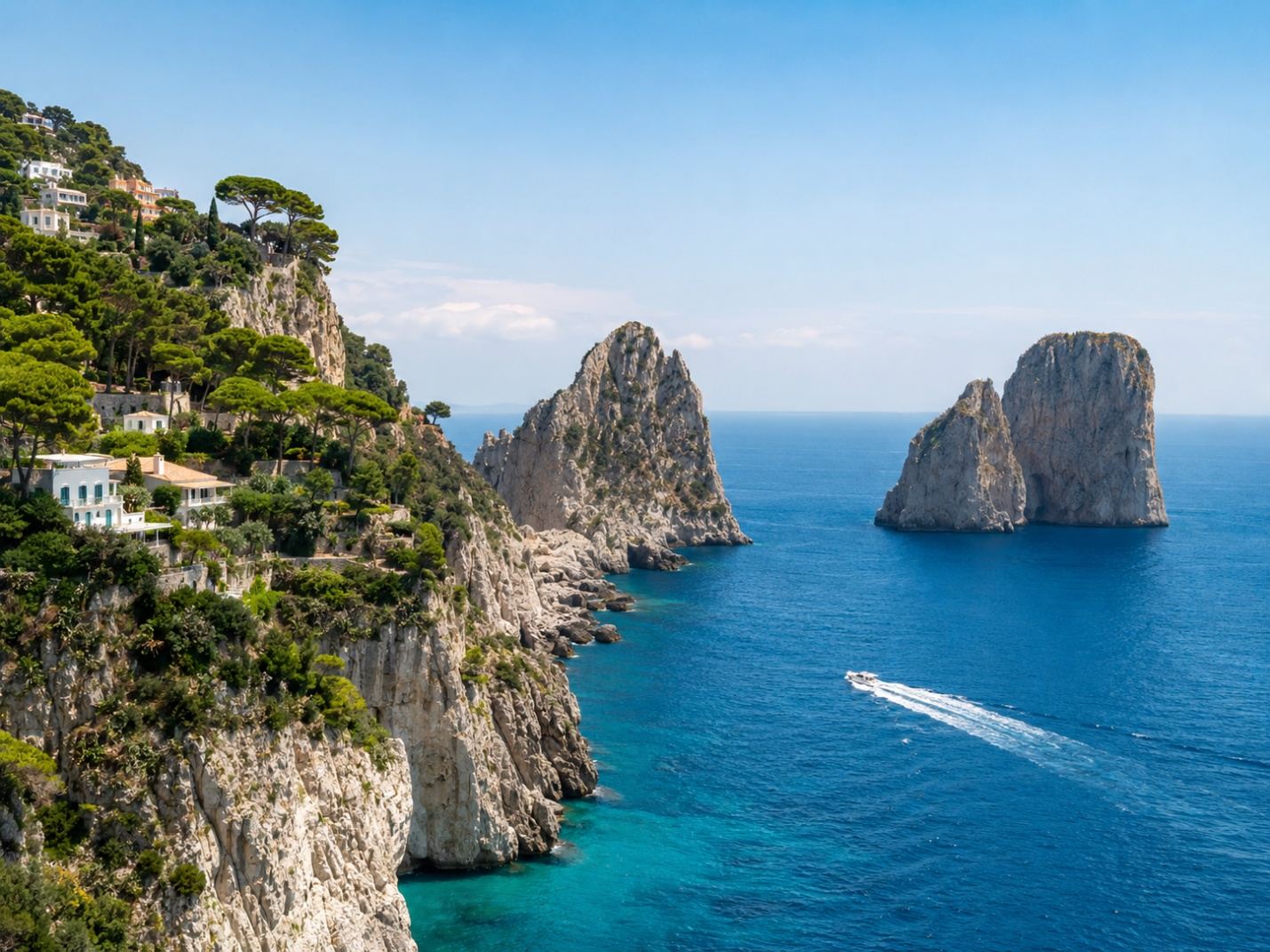
The Faraglioni, where the island runs out into the sea.
Give the last coastal day to the island, which is a different proposition from the mainland towns: sheer white limestone cliffs, water in a blue that genuinely does not photograph accurately, and a small elegant town that has been a retreat since the emperor Tiberius ran the Roman Empire from here. Take the morning ferry from Amalfi and go straight to the Blue Grotto before the day-trip boats arrive — a low sea cave where sunlight enters through an underwater opening and lights the whole cavern from below in an electric cobalt blue, entered lying flat in a rowboat through a gap barely a metre high.
Come back to Marina Grande, ride the funicular up to Capri town and its famous Piazzetta for lunch, then cross to Anacapri for the real highlight: a single-seat chairlift that carries you silently over gardens and vineyards to the summit of Monte Solaro, the island's highest point, with the whole Bay of Naples and the Faraglioni rocks laid out below. Take a late ferry back, or stay for aperitivo once the day-trippers have gone and the island quietly becomes itself again.
Insider Notes
- The Blue Grotto is weather-dependent and closes often. Rough seas or high tide make the entrance impassable, and it shuts by mid-afternoon regardless. Go first thing and have a plan B.
- Understand the Grotto system before you are in it: you transfer to a small rowboat at the cave mouth, pay separately, and the rowers expect a tip. It is chaotic and briefly feels like a hustle. It is also four minutes inside — worth it, with expectations managed.
- Check the return ferry times before you leave Amalfi. The last boat is earlier than dinner; missing it means an expensive night or a very long way round via Sorrento.
- The Monte Solaro chairlift is single-seat with no safety bar — twelve minutes with your feet over open gardens. Not for anyone uneasy with heights; there is a walking path as an alternative.
- Do not bring the car. Non-resident vehicles are barred from the island in high season, and Capri runs on funicular, bus, and open-top taxi anyway.
- The Piazzetta at midday belongs to the cruise crowd. Eat early or hold lunch until two — and if you can stay past five, the island empties dramatically.
Where to Eat
- Lunch — Da Paolino, dining under a canopy of lemon trees in Anacapri. Book ahead — the setting is the reason people come back.
- Alternative — Il Geranio, on a terrace above the Faraglioni, for the view as much as the seafood.
- Aperitivo — the Piazzetta after five, once the day boats have gone, for a spritz and the island's best people-watching.
- Gelato — Buonocore in Capri town, in a warm waffle cone pressed to order. The smell alone gives away the location.
Tickets & Costs
| Ferry, Amalfi to Capri, each way | €23–25 |
| Blue Grotto (entry + rowboat, plus tip) | €18 + tip |
| Funicular, Marina Grande to Capri town | €2.40 |
| Bus, Capri to Anacapri | €2.40 |
| Monte Solaro chairlift, return | €14 |
| Villa San Michele, Anacapri | €12 |
Day 13 · Rome
Pompeii and North to Rome
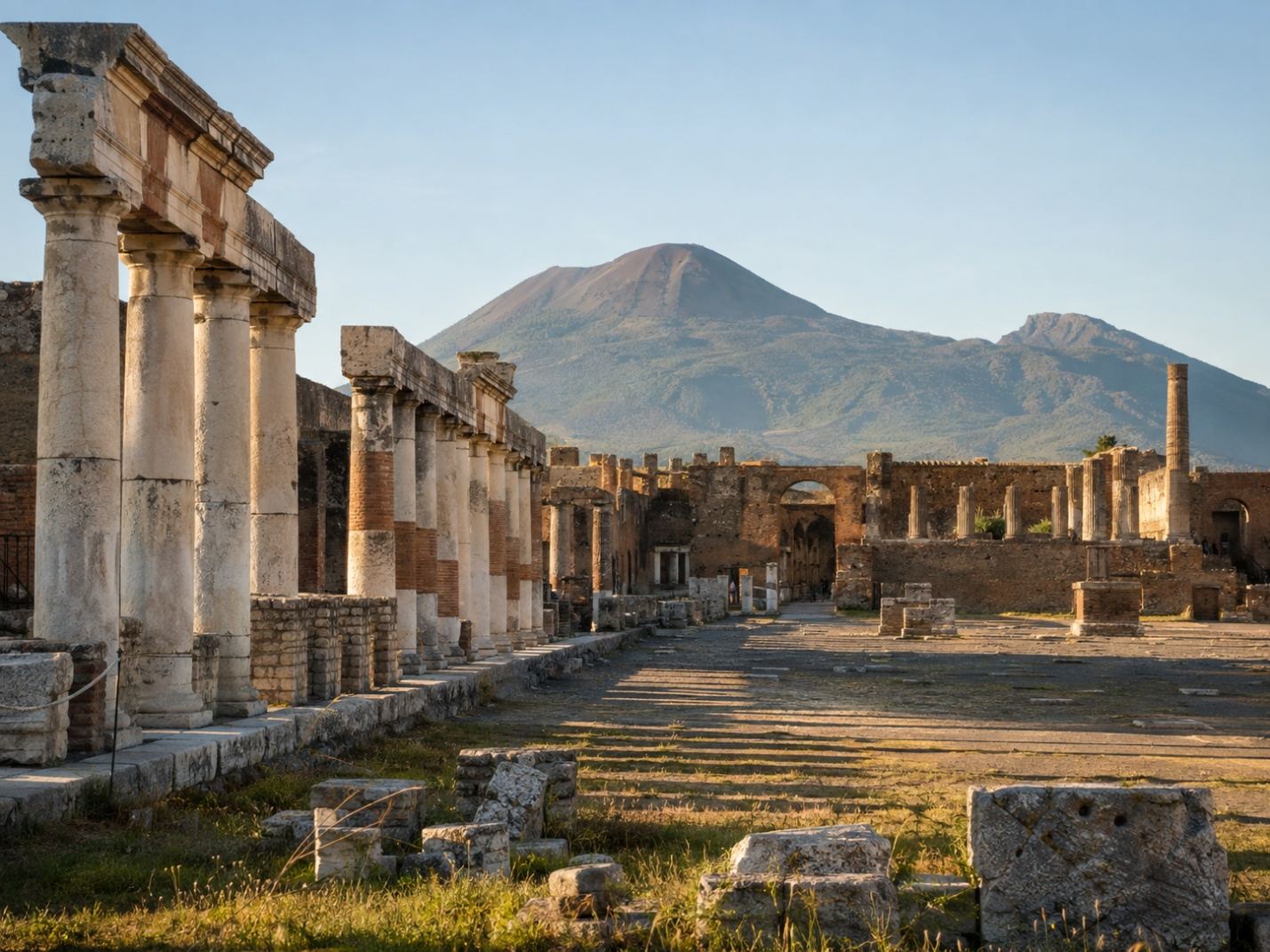
The city and the mountain that ended it, still facing each other.
Today you leave the coast, and the stop along the way is one of the most extraordinary places in Italy. Pompeii is an hour from Amalfi and directly on the route north — a full Roman city frozen by Vesuvius in AD 79, where you walk down rutted stone streets past bakeries with their millstones still standing, bars with the amphorae slots cut into the counters, and houses with frescoes and mosaic floors intact.
It is far larger than people expect, so treat it as a focused two to three hours with a plan rather than a wander. Then get back on the road and drive north to Rome, returning the car at Termini and checking into your hotel in the quiet, leafy Ludovisi quarter just above the Via Veneto. Dinner tonight should be close and unambitious — you will have driven the whole spine of the trip today, and Rome starts properly tomorrow.
Insider Notes
- Go early and take the heat seriously. June at Pompeii is brutal: essentially no shade, radiating stone, punishing midday. Hat, sunscreen, and more water than seems necessary.
- Enter at Porta Marina and book the ticket online — the on-site queue in high season is long and entirely avoidable.
- With limited time, follow one line: Forum, Baths of the Forum, House of the Faun, then Via dell'Abbondanza. Skip the amphitheatre and Villa of the Mysteries, both long walks to the far edges.
- The plaster casts are not bodies but voids — plaster poured into cavities left in the ash. Worth knowing beforehand, and worth mentioning to anyone traveling with children.
- Wear proper shoes. The original Roman paving is uneven, cambered, and cut with deep cart ruts — the single most common complaint from people who visited in sandals.
- Return the car before Rome, not in Rome. The drop at Termini is the right move; the historic center is a ZTL and driving into it earns camera fines by mail.
Where to Eat
- Lunch — President in Pompei town, a short walk from the site, for a proper meal rather than the tourist cafes at the gates.
- Simpler option — a pizza in Pompei's modern center. You are in the birthplace region; even the ordinary places are good.
- Dinner — Colline Emiliane, a small family-run Emilian kitchen near Piazza Barberini — the standout in the Ludovisi quarter. Book ahead.
- Gelato — Giolitti, near the Pantheon, if you have energy for a first evening walk. Rome's most famous gelateria, running since 1900.
Tickets & Costs
| Pompeii archaeological park, with booking fee | €18–22 + €1.50 |
| Audio guide / guided tour | €10 / €30–60 |
| Fuel and tolls, Amalfi to Rome | €50–60 |
| Taxi, Termini to hotel | €12–15 |
Day 14 · Rome
Ancient Rome — Colosseum, Forum, and the Pantheon
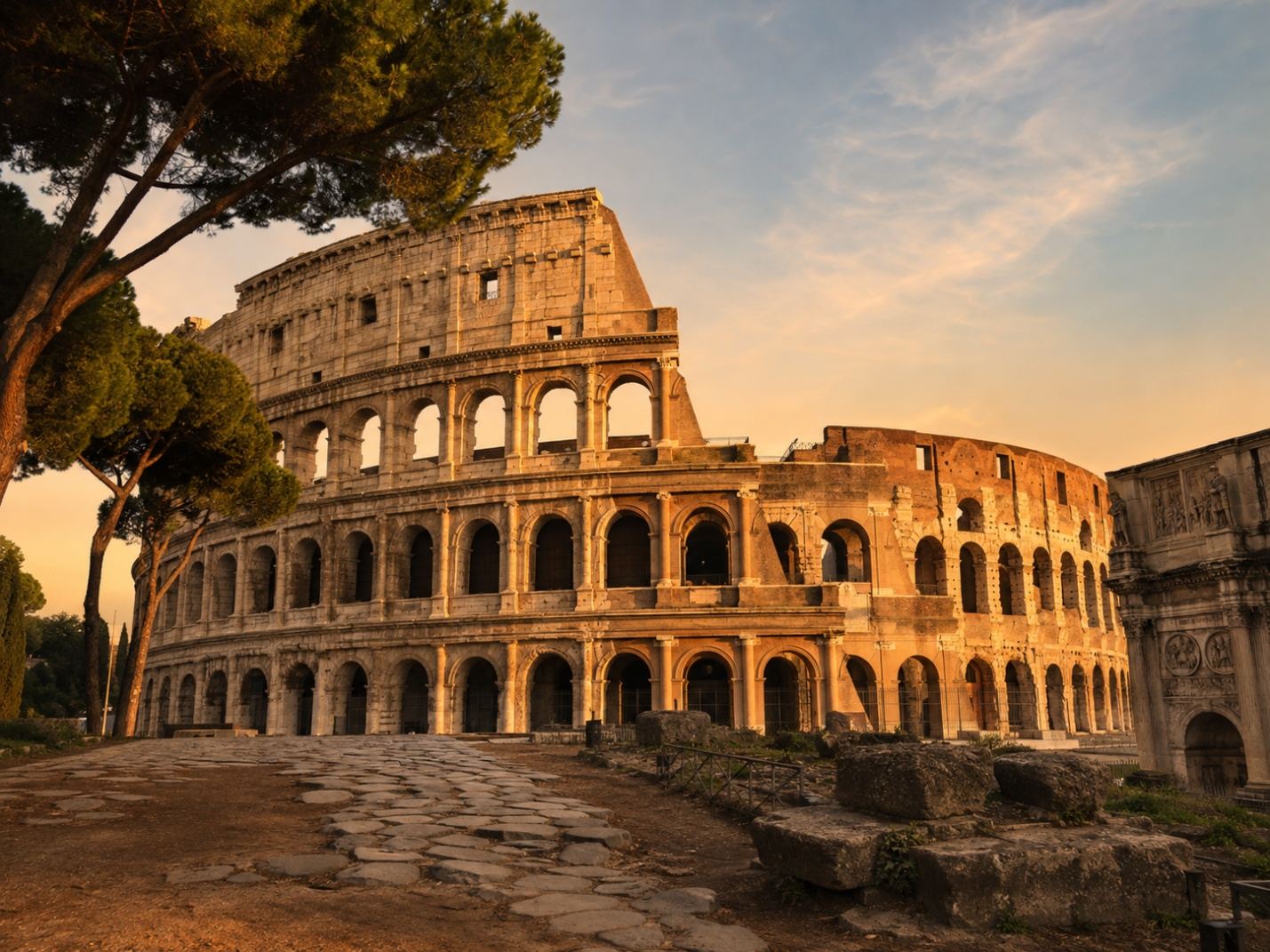
Nineteen centuries on, and still the shape the city is measured against.
Rome works best split by era rather than by neighbourhood, and today is the ancient one. Start at the Colosseum in the morning while the temperature is still manageable, then walk straight on into the Roman Forum and up onto the Palatine Hill on the same ticket. This is the right order, because the Colosseum impresses but the Forum is where the city actually makes sense — standing in the rutted stone of what was the political center of the Western world for six centuries, with the Palatine above it holding the ruins of the imperial palaces that gave us the word palace.
Break for lunch and the worst of the afternoon heat, then walk into the centro storico for the Pantheon, which has stood with its open oculus for nineteen hundred years and remains the largest unreinforced concrete dome ever built. Continue to Piazza Navona and Bernini's Fountain of the Four Rivers, finish at the Capitoline Hill for the view back down over the Forum at golden hour, and eat dinner in Monti. Save the Trevi Fountain for after dinner, when the floodlighting does its work.
Insider Notes
- The Colosseum requires a timed entry booked well in advance — June slots sell out days ahead. The combined ticket covers the Forum and Palatine across two days, but the Colosseum slot is fixed, so build the morning around it.
- Consider the arena floor or underground add-on. Standing where the gladiators entered is a substantially different experience from the standard tiers. It books separately, and early.
- Use the Via di San Gregorio gate for the Forum and Palatine — consistently quieter, and descending into the Forum from the Palatine gives you the whole layout before you walk through it.
- The Forum has almost no shade and no food. Bring water; go before noon or after four.
- The best free view in Rome is the Capitoline terrace behind the Palazzo Senatorio, looking straight down the length of the Forum. Take the stairs beside the Vittoriano and you arrive right at it.
- Fill your bottle at the nasoni, the cast-iron street fountains running cold mountain water all over the city. Block the spout with a finger and the water arcs upward to drink.
- Genuinely quiet at the Trevi means before seven in the morning. The coin goes in over your left shoulder with your right hand — and wading in carries a real fine.
Where to Eat
- Lunch — Ristoro della Salute, directly across from the Colosseum — convenient rather than remarkable. For something better, walk five minutes into Monti.
- Dinner — La Carbonara in Monti, an institution for the four Roman pastas: carbonara, cacio e pepe, amatriciana, and gricia. Book, or arrive at opening.
- Alternative — Taverna dei Fori Imperiali, small and warm, a short walk from the Forum.
- Gelato — Fatamorgana in Monti for unusual flavours done seriously, or Come il Latte near Piazza Barberini for the classics.
Tickets & Costs
| Colosseum, Forum & Palatine, combined ticket | €18 + €2 |
| Full Experience (arena floor & underground) | €24–26 |
| Pantheon | €5 |
| Capitoline Museums, optional | €13–16 |
| Guided Forum tour, optional | €40–70 |
Day 15 · Rome
Baroque Rome, the Great Basilicas, and Trastevere After Dark
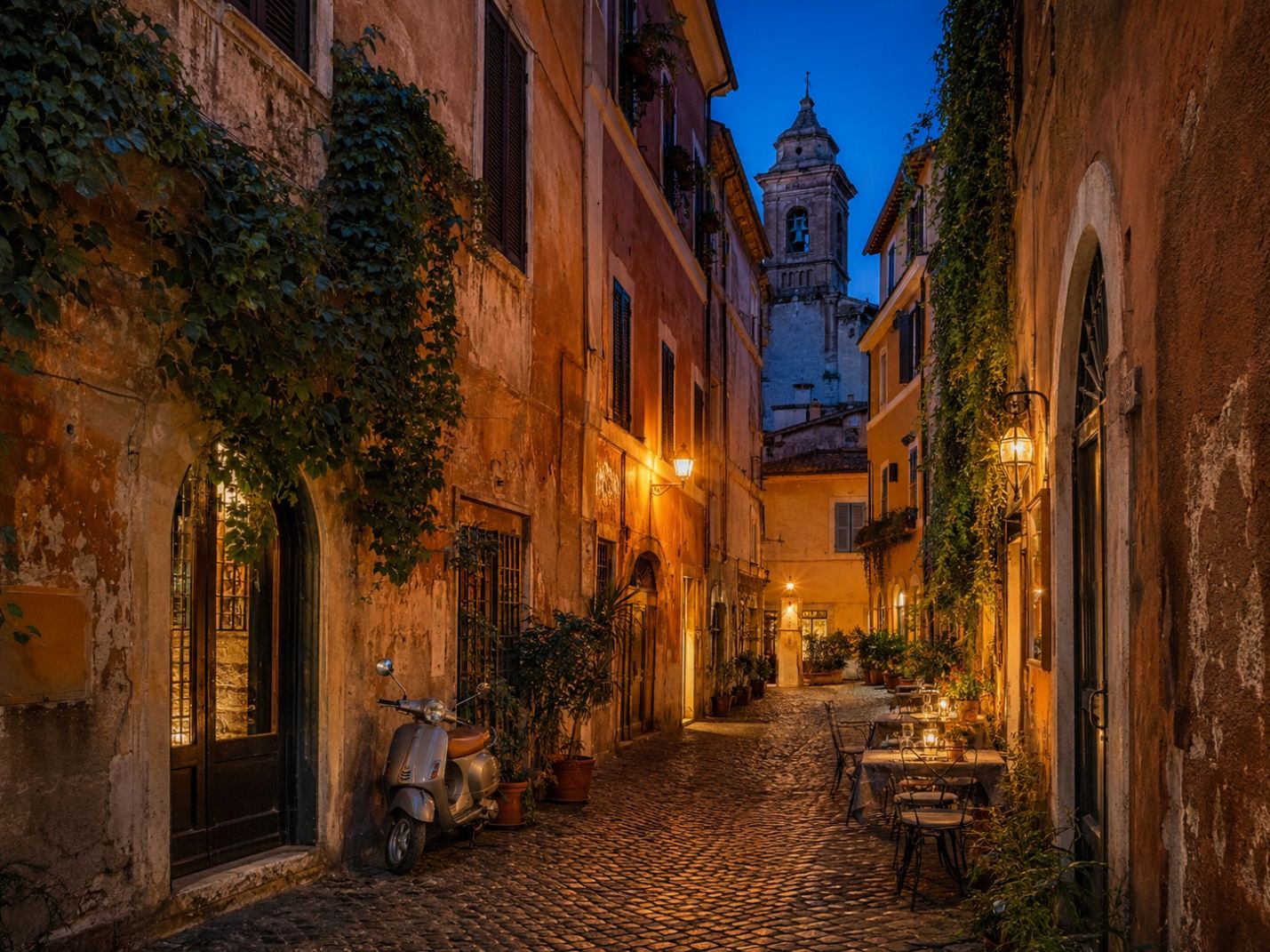
Trastevere after dark, where the lamps come on before the tables fill.
The second Roman day belongs to the Baroque, which is really the story of a few rival geniuses competing across the same handful of piazzas. Do the basilicas first while they are open and cool — Santa Maria Maggiore, whose fifth-century nave mosaics are the oldest in the city, and San Giovanni in Laterano, which is the actual cathedral of Rome and outranks St Peter's despite almost nobody knowing it — then work back into the center for Campo de' Fiori's morning market and Piazza Navona.
The Navona is built on the footprint of a Roman stadium, which is why it has that elongated shape, and Bernini's Fountain of the Four Rivers sits directly opposite a church facade by his rival Borromini. The two men detested each other, and Roman legend insists the river god recoils from the building — though the fountain was finished first and the story is entirely invented. Cross the river in the late afternoon to Trastevere, where medieval lanes and ivy-covered facades make the best evening walk in the city and Santa Maria in Trastevere holds twelfth-century gold mosaics that come alive once the lights go on. Dinner there, then the ghosts and mysteries tour to see the city's darker corners with the crowds gone.
Insider Notes
- The two great basilicas are east of the center and close for a long midday break. Morning solves the timing and gets you to Campo de' Fiori before the market packs up. Both enforce dress codes.
- Santa Maria Maggiore's coffered ceiling is said to be gilded with the first gold brought back from the Americas — a small detail that changes how you look at it.
- Piazza Navona rewards a slow lap. All three fountains deserve attention, and the excavated stadium ruins beneath the north end are a quiet stop almost nobody makes.
- Trastevere changes character by the hour. Afternoon is quiet lanes and artisan workshops; after nine it turns loud and young. Dinner around eight gets you the best of both.
- Confirm the ghost tour's meeting point, duration, and language when you book — several operators run overlapping routes and quality varies a great deal.
- This is a long walking day. The metro between Termini, San Giovanni, and the center saves your legs for the evening, which is the part worth having energy for.
Where to Eat
- Lunch — Roscioli, near Campo de' Fiori — part deli, part wine bar, part restaurant, and one of the best carbonaras in Rome. Book, always.
- Dinner — Da Enzo al 29 in Trastevere: tiny, family-run, cash-only, worth the wait. Arrive at opening.
- Alternative — Roma Sparita, on a quiet Trastevere piazza, famous for cacio e pepe served in a crisp parmesan basket.
- Gelato — Otaleg in Trastevere — gelato spelled backwards — for some of the most technically serious gelato in the city.
Tickets & Costs
| Santa Maria Maggiore | Free (museum €5) |
| San Giovanni in Laterano | Free (cloister €5) |
| Ghosts & mysteries walking tour | €25–35 |
| Trevi, Navona, Campo de' Fiori | Free |
| Metro single / 24-hour | €1.50 / €7 |
Day 16 · Rome
The Vatican
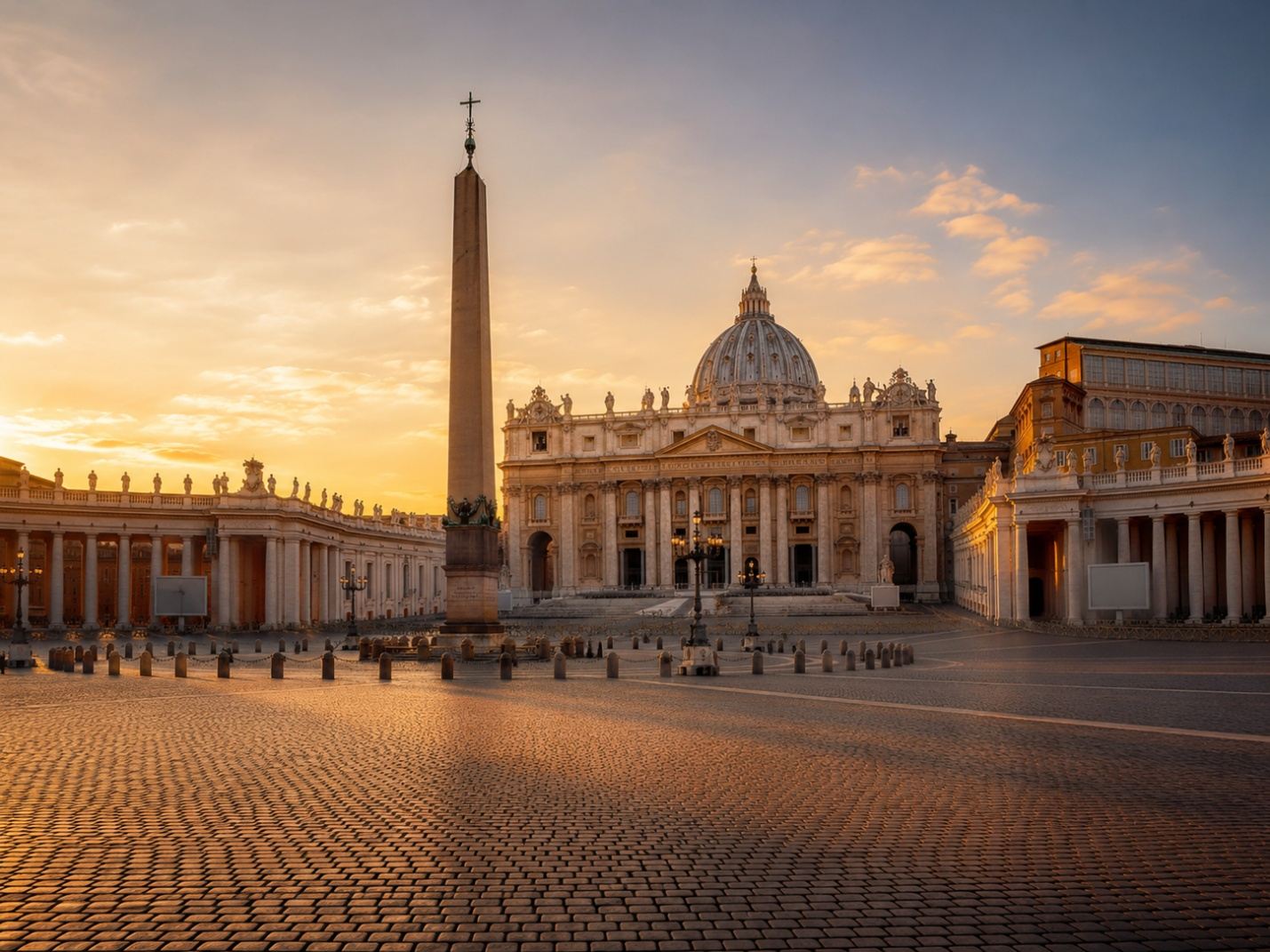
Where the money and the power ended up — and it shows.
Save the Vatican for last, because everything else in Rome makes more sense once you have seen where the money and power ended up. Go early with a pre-booked ticket to the Vatican Museums, and understand the geography before you start: the museums are a long one-way route of galleries, tapestries, maps, and Raphael rooms that all funnel eventually toward the Sistine Chapel, and the walk is longer than anyone expects.
The Chapel itself is worth slowing down for. Michelangelo spent four years on the ceiling, largely standing rather than lying down as the myth has it, and painted the Last Judgment on the altar wall twenty-five years later in a considerably darker mood. Come out into St Peter's Basilica afterward for the sheer scale of it and for the Pietà just inside the door, then have a long lunch in Prati and spend the afternoon at whatever pace you like. Tonight is your last Italian dinner, so make it a good one.
Insider Notes
- Book the first entry slot of the day. By ten the galleries are shoulder-to-shoulder and the Sistine Chapel becomes an unpleasant crush. Early access costs more and is genuinely worth it here.
- There is a direct passage from the Sistine Chapel into St Peter's normally reserved for tour groups. With a guide you use it and save an hour; independently, you exit and re-queue at the basilica.
- Dress code is strictly enforced at both — shoulders and knees covered, for everyone. People are turned away daily, and there is no cloakroom fix.
- No photography in the Sistine Chapel, and guards enforce it loudly. Silence is also technically required.
- The dome climb is separate and worth it: 551 steps, or a lift to the roof and 320 from there, the last stretch narrow and slanted as the dome curves. The view down the nave from the interior gallery is the better half.
- Skip the restaurants immediately outside the walls. Fifteen minutes into Prati, Roman office workers eat and prices halve.
Where to Eat
- Lunch — Bonci Pizzarium near the Cipro metro, widely considered Rome's best pizza al taglio. Standing room only, worth the detour.
- Alternative — L'Arcangelo in Prati, a refined but unstuffy Roman kitchen.
- Farewell dinner — Armando al Pantheon, family-run since 1961 and one of the most reliable classic Roman kitchens in the center. Book weeks ahead — this is the one reservation to make early.
- Gelato — Gelateria dei Gracchi in Prati, small-batch and excellent, a short walk from St Peter's.
Tickets & Costs
| Vatican Museums & Sistine Chapel, with booking | €20 + €5 |
| Early-access / skip-the-line guided tour | €60–90 |
| St Peter's Basilica | Free |
| Dome climb, stairs / lift + stairs | €10 / €15 |
| Treasury / necropolis, optional | €5 / €13 |
Day 17 · Rome
Departure
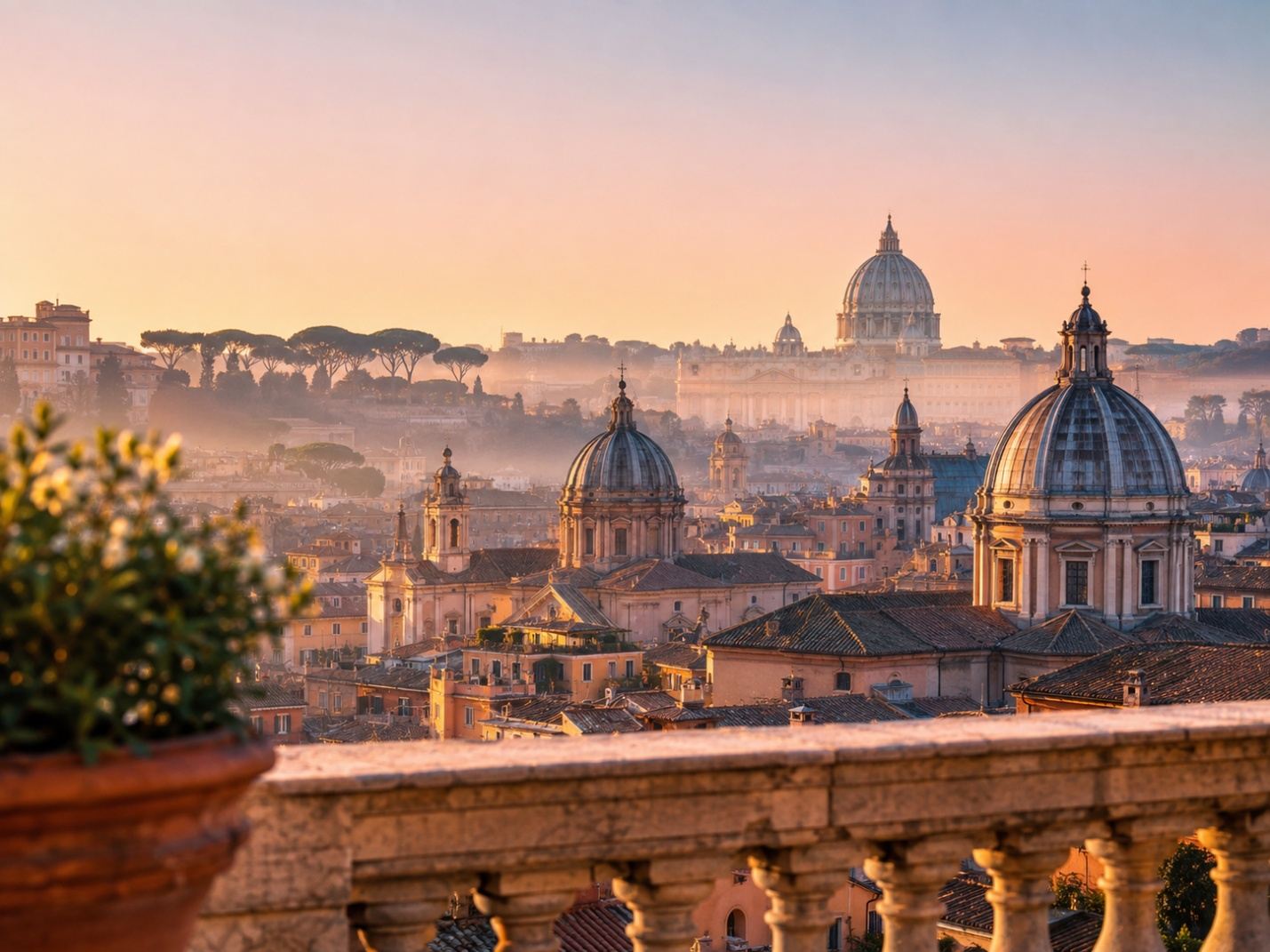
Seventeen days, five Italies, and one more coffee before the airport.
A last unhurried breakfast, and then Rome does you the small kindness of an early-afternoon flight — enough time for one final walk without the day feeling like an airport transfer from the start. Take a coffee standing at the bar the way Romans do, walk one more lap of a piazza you liked, and leave the hotel around 11:30 for Fiumicino, roughly forty-five minutes by taxi in normal traffic.
Toast the trip with a glass of wine after security, the same way it began seventeen days ago at the other end.
Insider Notes
- Book the fixed-rate taxi to Fiumicino. The flat fare from inside the Aurelian Walls is set by the city and covers luggage — agree on it before setting off rather than running the meter.
- Three hours before an intercontinental flight is right in summer, not two. Fiumicino is large, and Terminal 3 handles most long-haul departures.
- Claim your VAT refund before check-in, not after. You need the stamped forms, the goods available for inspection, and considerably more time than the queue suggests.
- Buy last-minute food gifts at the airport rather than in the city — airside shops sell travel-safe versions with the paperwork sorted.
One Last Meal
- Last coffee — Sant'Eustachio Il Caffè or Tazza d'Oro, both near the Pantheon and both worth the small detour. Standing at the bar costs a fraction of sitting down.
- Breakfast — at the hotel, unhurried, and then a cornetto at whichever bar you have adopted over four days in Rome.
Tickets & Costs
| Fixed-rate taxi, city center to Fiumicino (per car) | €50 |
| Leonardo Express train, Termini to FCO | €14 |
| Airport luggage storage, if needed | €6–10 |
Photographs From Our Own Travels
This is the trip as we lived it.
Every image below is ours — from a golden-hour photoshoot in Venice to phone shots grabbed between gelato stops. This is what seventeen days across Italy actually look like.


Before You Go
Book these before you leave home.
Five things on this itinerary sell out days to weeks ahead in June, and there is no walk-up alternative for any of them. Admissions and excursions total roughly €400–500 per person.
The five that sell out
- Brunelleschi's dome climb in Florence — a separate timed reservation, not covered by simply holding a Duomo pass
- The Accademia Gallery, for David
- The Colosseum timed entry — and the arena or underground add-on if you want it
- The Vatican Museums, ideally the first slot of the day
- Pompeii, to avoid a long queue in full sun
- Plus one table: Armando al Pantheon in Rome, booked weeks out.
Before you go — passports, ETIAS, and driving permits
- Italy is in the Schengen area, so Canadian and US passports need no visa for stays under ninety days — but your passport must be valid for at least three months beyond your departure date and carry two blank pages. ETIAS, the EU's pre-travel authorization, is being phased in — check its current status before you travel.
- Bring your driver's licence and an International Driving Permit. Italy legally requires the IDP alongside a foreign licence, rental desks increasingly ask for it, and police checks on the Amalfi road do happen. Obtain it from CAA or AAA before departure; it cannot be issued once you are in Italy.
Money and payment
- Cards are widely accepted, but Italy still runs on cash more than you would expect — small trattorias, market stalls, Blue Grotto tips, and church donation boxes all want euros.
- Use bank ATMs, not standalone kiosks in tourist areas.
- Always decline being charged in dollars — dynamic currency conversion sets the exchange rate against you.
- Tipping is not expected; rounding up for good service is plenty. A coperto cover charge of €2–4 per person is normal and not a scam.
Driving — the two things that cost people money
- ZTL zones. Nearly every historic center on this route is a camera-monitored restricted-traffic zone. Fines arrive by mail months later, one per entry, plus a rental-company admin charge. Park outside the walls, always.
- Autostrada tolls. Ticket in, pay on exit. Use the white or blue lanes at the exit — never the yellow Telepass lanes.
- Fuel. Benzina is petrol, gasolio is diesel. Confirm which your rental takes; misfuelling is an expensive tow.
June — the seasonal reality
- High season, and hot: low-to-mid thirties Celsius in Rome and Florence, humid on the coast, with the Forum and Pompeii offering essentially no shade. Sightsee early, take a genuine midday break, and go out again from five.
- Many shops and smaller churches observe riposo, closing roughly one to four. Restaurant kitchens open around 7:30 for dinner, not before. Sunday is quiet everywhere; Monday closes many museums, though the major Rome and Florence sites on this itinerary run seven days a week.
Practical odds and ends
- Water is free and excellent. Refill at the nasoni in Rome and public fountains everywhere else.
- Shoes decide how much you enjoy this trip. Cobbles, cart ruts, stairs, and stone lanes — broken-in walking shoes, not new sandals.
- Dress codes are enforced, not suggested — shoulders and knees covered at every major church. A light scarf in the day bag solves it.
- Pickpocketing concentrates on Rome's metro line A, the 64 bus, Termini, and the crush at the Trevi and Vatican. Front pockets, zipped bag.
- Get an eSIM before you leave — far cheaper than roaming, active on landing.
- Learn six words: buongiorno, buonasera, per favore, grazie, permesso, scusi. Greeting a shopkeeper before you ask anything is a genuine social expectation, and the difference in warmth you get back is immediate.
- Pack light for this route specifically. You will haul bags over Venice's bridges, up Cortona's hill, and down Amalfi's stairs. One medium case each, plus a folding duffel for the glass and leather you will inevitably buy.
- VAT refunds apply on purchases over €70 from a single store — claim at the airport before check-in, goods accessible.
- The emergency number is 112 throughout Italy. Travel medical coverage is worth having, particularly given the driving portion of this trip.