A curated journey · Designed and researched by Parth
Four Days in San Francisco
The Embarcadero · The Golden Gate · Marin · Half Moon Bay — a city built for walking, biking, and one bridge that never photographs the same way twice.
Curator's Statement
San Francisco rewards the traveler who leaves the car parked and walks.
Four days is the right length for this city — enough for the icons that earn their reputation honestly, a full day across the Golden Gate into Marin, and a day down the coast that most visitors never make time for. The parking is a genuine cost here, not a formality, and every plan in this itinerary is built around foot, bike, cable car and ferry instead. Do it this way and San Francisco stops feeling like a checklist of famous names and starts feeling like the small, walkable, oddly intimate city it actually is.
Four days, two of them without a car at all, and not one of them spent looking for a parking space.
Each day below opens with a short narrative, followed by insider notes on the things that are easy to get wrong here, where to eat, a sundowner for every evening, and the ticket costs for anything mentioned. Prices are in US dollars and move with demand and season; confirm at the point of booking.
The Route at a Glance
Two days in the city, one across the bridge, one down the coast.
The four days
| When | Where | Focus |
|---|---|---|
| Day 1 | San Francisco | The icons — Alcatraz, the cable car, Lombard, Chinatown, and a choice of park or cliffs |
| Day 2 | The Golden Gate & the Mission | The bridge by bike, Sausalito, the Painted Ladies, Valencia Street |
| Day 3 | Marin | Watershed, Mount Tamalpais, Muir Woods |
| Day 4 | Half Moon Bay | The coast south of the city — Devil's Slide, Mavericks, Pescadero |
| All four nights | San Francisco | One hotel, unpacked once (or three in the city and one at Cavallo Point) |
How you move
- Into San Francisco — fly into SFO and take a rideshare or taxi downtown: thirty-five to forty-five minutes, and cheaper than most people expect.
- Days 1 and 2, no car at all — overnight parking runs $60 to $80 a night downtown, and every place on those two days is reachable by bike, cable car, ferry or a short ride. Do not rent at the airport.
- Day 3 needs a car — Marin is the one day no ferry, bike or cable car reaches. Take a one-day rental, or collect a car downtown that morning and return it that evening; either costs less than four nights of hotel parking.
- Day 4 runs on the same wheels — Highway 1 south to Half Moon Bay is a driving day too. If you are doing both, keep the car for the two days rather than renting twice.
- The Golden Gate toll is southbound only — coming back into the city on Day 3. It is all-electronic and there is no booth: the rental company will bill it to the car's plate and add a fee, so pay it yourself online at goldengate.org within 48 hours of crossing and the surcharge disappears.
- Going on afterward — if wine country or the coast road follows these four days, collect the rental car on your way out of the city rather than on arrival.
This structure exists for a reason. San Francisco is a city where a car is a liability: parking is expensive, the hills are hard on nerves and gearboxes, and the neighborhoods are closer on foot than they look on a map. Renting only for the two days you actually drive saves four nights of parking and a great deal of temper.
Part of the Highway 1 route
This itinerary is the long version of Days 1 to 3 of the eleven-day Highway 1 journey — the same city, given a fourth day and a full day in Marin. Follow it on its own for a long weekend, or use it as the opening act and pick the road trip up in Sonoma.
What This Trip Costs
Roughly $3,100 for two, done comfortably.
Two travelers sharing a room at The Classic tier, four nights, in September or October — the finest weather of the year in this city, and priced accordingly.
Estimated budget · Two travelers · 4 nights
| Accommodation — 4 nights at The Classic tier, including tax and fees | $1,600 |
| Food and drink — lunches, dinners, coffee, and a sundowner every evening | $1,000 |
| Attractions and tickets — Alcatraz, bikes, cable cars, museum entries | $350 |
| Rideshares — airport transfer and short hops within the city | $150 |
| Total, excluding car rental | ≈ $3,100 |
Where the money actually goes: accommodation is half of it, and there is no way around that — San Francisco has no cheap nights and adds over sixteen percent in tax on top of the rate. Food is the second line and the one worth stretching: this is a city where a few dollars at a Chinatown takeout window and a $200 dinner on Divisadero are both worth doing, and where the sundowner is usually free.
Leaner
≈ $2,400
Choose Hotel Kabuki or a well-reviewed Nob Hill inn, walk more and ride less, and treat one dinner rather than two as the splurge. Nothing in the four days changes.
Elevated
$6,000+
The Four Seasons or the Ritz-Carlton, a private Alcatraz and city tour, and dinner at State Bird Provisions or Nopa with the wine pairing.
Car rental is not included above — the Marin and Half Moon Bay days need one, and a two-day mid-size rental collected downtown runs roughly $150 to $250 including fuel, plus the $10 bridge toll. Costs are estimates in US dollars and are intended for planning. They are not a quotation; final pricing depends on travel dates, availability, and how you choose to travel.
Day 1 · San Francisco
The Icons, in the Right Order
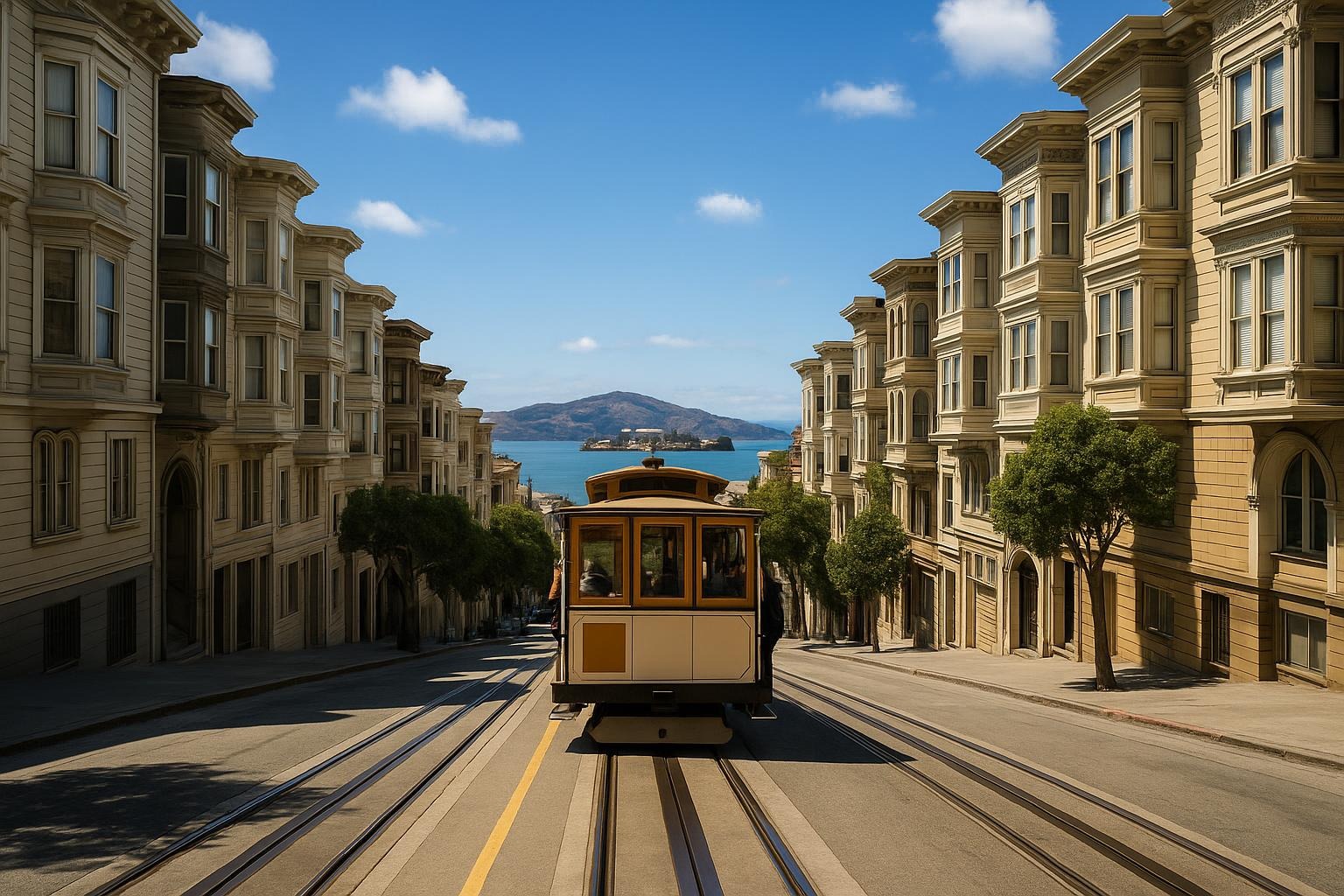
A cable car cresting the hill with the bay laid out below — San Francisco's oldest piece of theatre, still running on time.
Land at SFO and go straight downtown; the drive up the 101 takes forty minutes and delivers the whole afternoon still intact. Check in, and — a note on neighborhoods worth reading before you set out — San Francisco's street issues are real but concentrated in the Tenderloin, Civic Center and Mid-Market, roughly the blocks west of Mason Street and along Market between 5th and 10th. Everything in this itinerary sits well clear of them.
Book Alcatraz for the first boat of the morning, sixty to ninety days ahead — the island is quiet before the crowds and the cellhouse audio tour lands harder in that stillness. Already done it? Take the Night Tour instead for a genuinely different island after dark. Back on the mainland by late morning, walk Fisherman's Wharf to the Hyde Street cable car turnaround, ride up and over the hill, and step off at Lombard Street to walk down its eight hairpin turns on foot — the sidewalk stairs take five minutes and give a better view than the hour-long queue of cars crawling the curves. From there, drift through North Beach and Chinatown: the fortune cookie factory in Ross Alley, City Lights bookstore, a dim sum lunch in Portsmouth Square.
The afternoon is a choice rather than an attempt at both. Golden Gate Park — the de Young Museum's free observation tower, the Japanese Tea Garden, the bison paddock — is the gentle option. Lands End is the dramatic one: a clifftop trail through wind-bent cypress from the Legion of Honor to the ruins of the Sutro Baths, timed to finish at sunset with the bridge appearing around the headland.
Where to Stay · San Francisco, four nights
Every hotel here sits well clear of the Tenderloin, Civic Center and Mid-Market.
The Classic
$300–400 a night- Stanford Court, Nob HillAt the very top of the hill beside Grace Cathedral and Huntington Park, with the California Street cable car at the door. The calm, classic address, and usually under the band.
- The Clancy, Autograph Collection, SoMaFor fourOn the Embarcadero side of SoMa by Salesforce Park and Oracle Park; roomy double-queen rooms make it the pick for four friends.
- Hotel Kabuki, JapantownCalm, design-led, with Japanese soaking tubs; a short ride from everything, and the value pick if the budget is doing the deciding.
- Hotel Drisco, Pacific HeightsWildcardA mansion-district hideaway on the city's quietest streets, with an evening wine hour and a morning house car downtown. Runs $400 to $500 and worth it for anyone who wants zero city grit.
The Elevated
$600–1,000 a night- Four Seasons Hotel San Francisco at EmbarcaderoTower rooms over the Bay Bridge — the best-located luxury address in the city.
- The Ritz-Carlton, San FranciscoNob Hill grandeur at the Chinatown border, walking distance to North Beach.
- Cavallo Point Lodge, SausalitoWildcardSleep beneath the Golden Gate in converted army officers' quarters. Consider it for the night before the Marin day, so that you wake up on the Marin side with Mill Valley twenty minutes away.
Insider Notes
- Alcatraz tickets are sold only by Alcatraz City Cruises, and only in advance. Anyone selling tickets on the Embarcadero itself is selling a bay cruise that merely passes the island.
- Board the cable car at Hyde and Beach by the Wharf, not at Powell and Market, where the queue can run an hour. The Hyde Street hill is also the most dramatic drop on the system, and Lombard is a few stops up.
- The Painted Ladies at Alamo Square — the row of Victorian houses from the opening of Full House — are a short ride from North Beach if you have an extra hour; best photographed from the top of the park's east slope in late afternoon. They are also built into Day 2, so do not force them today.
- Golden Gate Park suits the couple with tired legs; Lands End suits the group that wants drama. Lands End is about three miles round trip with some steps; the park is flat and has cafés.
- Do not rent a car at the airport. Overnight parking downtown runs $60 to $80, the hills are hard on nerves and gearboxes, and the first two days are entirely reachable on foot, by bike or by a ten-dollar ride. The car comes on Day 3.
- Bring a jacket for the evening, in any month. The fog arrives around four and the temperature drops fifteen degrees with it. Mark Twain's line about the coldest winter being a summer in San Francisco is misattributed, but it is not wrong.
Where to Eat
- Lunch — dim sum at Good Mong Kok on Stockton Street, a takeout counter with a line, cash only, eaten in Portsmouth Square with the tai chi and the card games.
- Dinner — Sotto Mare in North Beach for the crab cioppino. No reservations taken, so arrive by 6:30 or expect to wait with a glass of wine on the sidewalk.
- Sundowner — the Sutro Baths ruins at Lands End as the sun goes into the Pacific, or Pier 7's wooden pier just north of the Ferry Building for the Bay Bridge lights coming on. Both are free, and both are the best view in the city for nothing.
Tickets & Costs
| Rideshare, SFO to downtown | $45–70 |
| Alcatraz Day Tour / Night Tour, per person | $45 / $56 |
| Cable car, single ride | $8 |
| de Young Museum (tower free without ticket) | $20 |
| Japanese Tea Garden | $15 |
| Lands End trail and Sutro Baths | Free |
Day 2 · The Golden Gate & the Mission
The Bridge, Sausalito, and the Painted Ladies
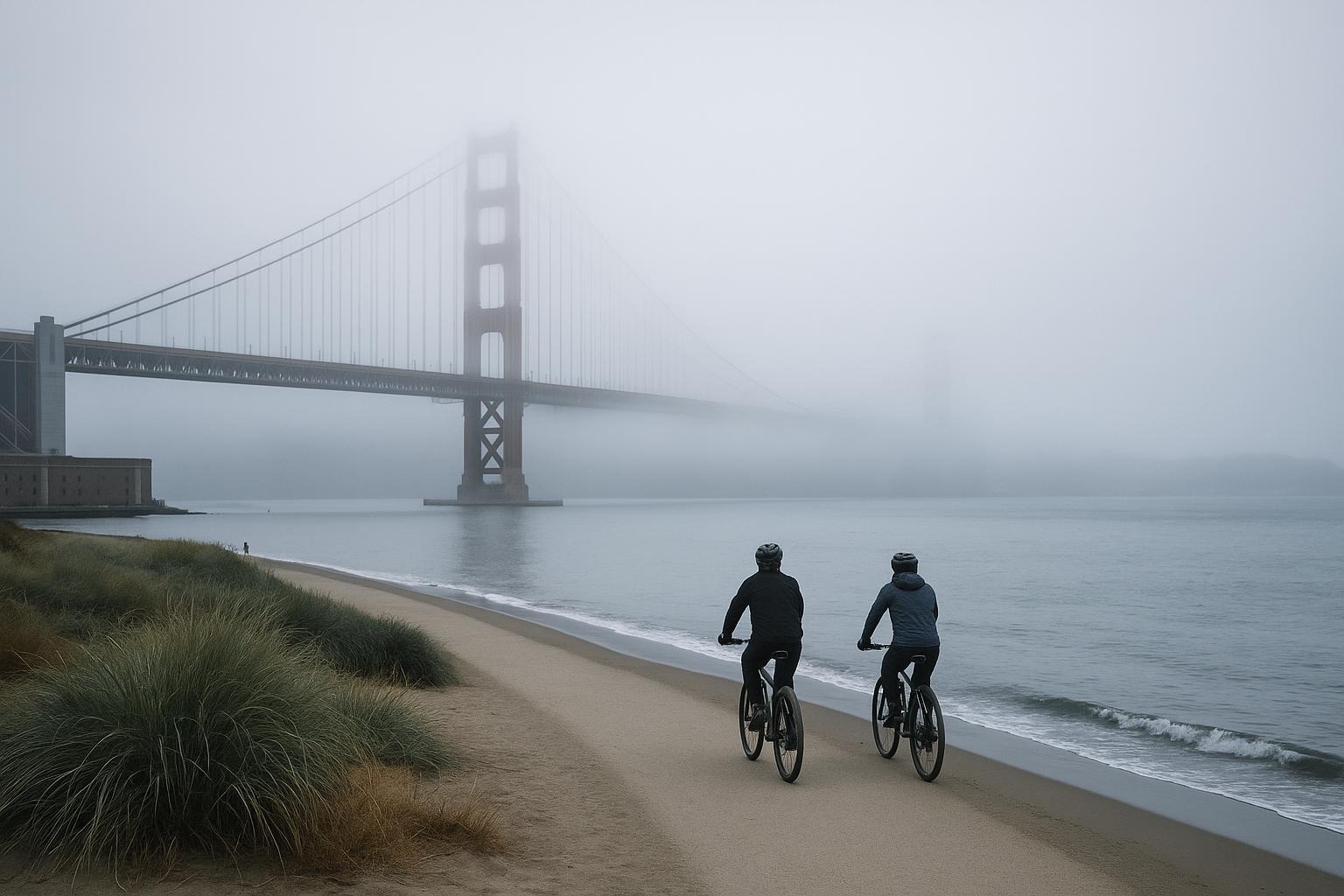
Crissy Field at nine, the bridge growing ahead, and the fog still deciding whether to lift.
Rent bikes at Fisherman's Wharf around nine and ride west along the Marina Green and Crissy Field with the bridge growing ahead. Cross it — a mile and three-quarters of wind, fog and the strange vertigo of towers vanishing into cloud — and drop into Sausalito on the far side, a fishing village turned artists' colony hanging on the hillside like a piece of the Italian Riviera. Lunch on the water, a walk past the houseboats at Waldo Point Harbor, and the ferry back across the bay with the bikes stowed on deck — a half hour of skyline and Alcatraz for the price of a bus fare.
Spend the afternoon on the north side of the city: the Presidio's Tunnel Tops park for the picnic-blanket view of the bridge you just rode, the Palace of Fine Arts, and a short ride to Alamo Square for the Painted Ladies against the downtown skyline. The evening belongs to the Mission — Dolores Park at golden hour, the murals in Clarion Alley, and dinner on Valencia Street, where the city's best kitchens have been for fifteen years.
Insider Notes
- Take the ferry back rather than riding the bridge twice. The ride into Sausalito is downhill; the ride out is the same hill in reverse with a headwind. Bikes ride free on the Golden Gate Ferry, and it lands you at the Ferry Building.
- Be on the bridge before eleven, before the fog burns off and the afternoon wind picks up. Cyclists use the east sidewalk on weekdays, the west on weekends.
- Walk the houseboats at Waldo Point Harbor — a floating neighborhood of four hundred homes, some of them converted ferries, that has been there since the 1960s. Respectful, quiet, and a ten-minute ride north of the ferry pier.
- Alamo Square is a park, not a museum. The classic photograph is taken from the top of the slope on the east side, looking down at the houses with the skyline behind. Late afternoon puts the sun on the facades.
- Book dinner in the Mission a week ahead; the good rooms on Valencia and 18th are small. Dolores Park at sunset on a warm day is the closest the city gets to a beach.
Where to Eat
- Lunch — Bar Bocce on the Sausalito waterfront, pizza and salads at picnic tables on the sand. Casual, and worth the ride.
- Dinner — Che Fico on Divisadero, Roman-Jewish and Californian at once — loud, delicious, and one of the hardest tables in the city. Book the day reservations open.
- Sundowner — Trick Dog on 20th Street, whose cocktail menu changes theme twice a year and has been the best bar in the Mission for a decade. Or a bottle in Dolores Park with everyone else, which is what the neighborhood does.
Tickets & Costs
| Bike rental, full day, per person | $40–55 |
| Golden Gate Ferry, Sausalito to the city, bikes free, per person | $14–15 |
| Presidio, Alamo Square, Palace of Fine Arts | Free |
Day 3 · Marin
Watershed, Mount Tamalpais, and Muir Woods
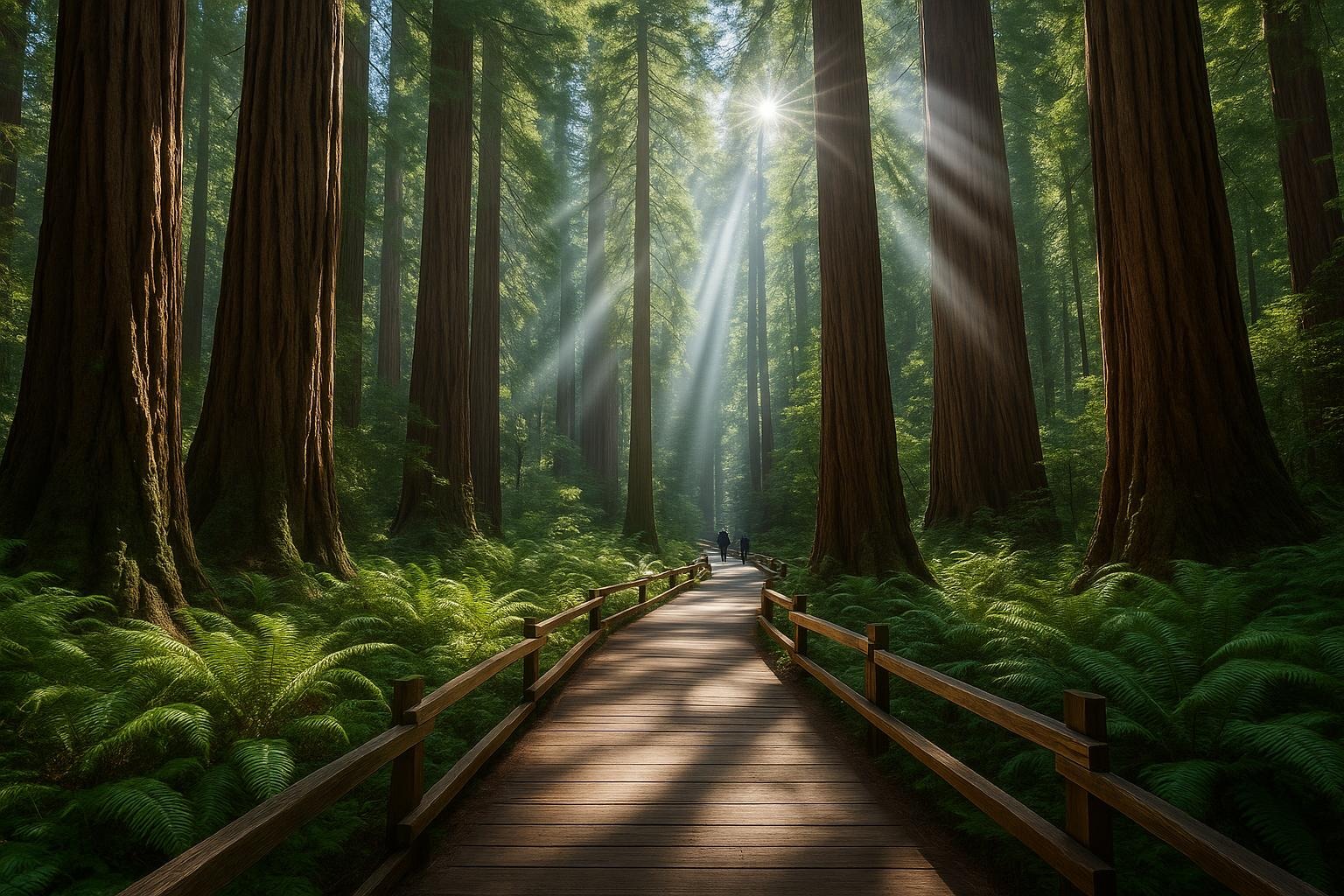
Light coming down through a thousand years of redwood — twenty minutes from the bridge, and another world.
Cross the Golden Gate with the car this time, and pull off in Mill Valley for brunch at Watershed, a wood-fired California kitchen in the restored 1892 Lumberyard with a deck that hangs over a creek and Mount Tamalpais filling the sky behind it. It is the kind of place that explains why nobody who lives here ever leaves. From there, the mountain itself: road cyclists climb via Panoramic Highway, mountain bikers take Old Railroad Grade — the birthplace of the sport — and everyone else simply drives to the East Peak for a view over the entire bay. Muir Woods is on the way down, a grove of old-growth coastal redwoods some of them over a thousand years old; parking and shuttle reservations are required and should be booked well ahead. If there is time, Muir Beach Overlook and Stinson Beach round out the afternoon before crossing back over the bridge for a last dinner in the city.
Insider Notes
- Book Muir Woods parking or the shuttle in advance — it is required, not optional, and sells out on weekends.
- Watershed's weekend brunch fills the deck by ten; reserve ahead. Twenty minutes from the bridge, and directly on the way.
- Mount Tamalpais, not Mount Diablo, is the mountain that pairs with this day. Diablo sits ninety minutes east in the opposite direction and belongs to a different itinerary entirely.
- The Golden Gate Bridge is tolled southbound only, and it is all-electronic — there is no booth. You pay nothing going out this morning; coming back into the city this evening, the toll will be billed to the rental car's plate and the rental company will add a fee. Pay it yourself online at goldengate.org within 48 hours of crossing and you avoid the surcharge.
Where to Eat
- Brunch — Watershed in the Mill Valley Lumberyard: wood-fired pizzas, the Stemple Creek burger, a BLAT on Parkside sourdough — on the creekside deck.
- Dinner — back in the city, Zuni Café on Market Street for the roast chicken for two, ordered the moment you sit down because it takes an hour, and the best Caesar in the city while you wait.
- Sundowner — Stinson Beach at low tide, if the afternoon allows it, or a glass of wine on the Zuni rooftop.
Tickets & Costs
| Muir Woods entry and parking/shuttle reservation, per person | $15–20 |
| Mount Tamalpais State Park, day use, per vehicle | Free–$8 |
| Golden Gate Bridge toll (southbound only, pay online within 48 hrs) | $10 |
Day 4 · Half Moon Bay
The Coast South of the City
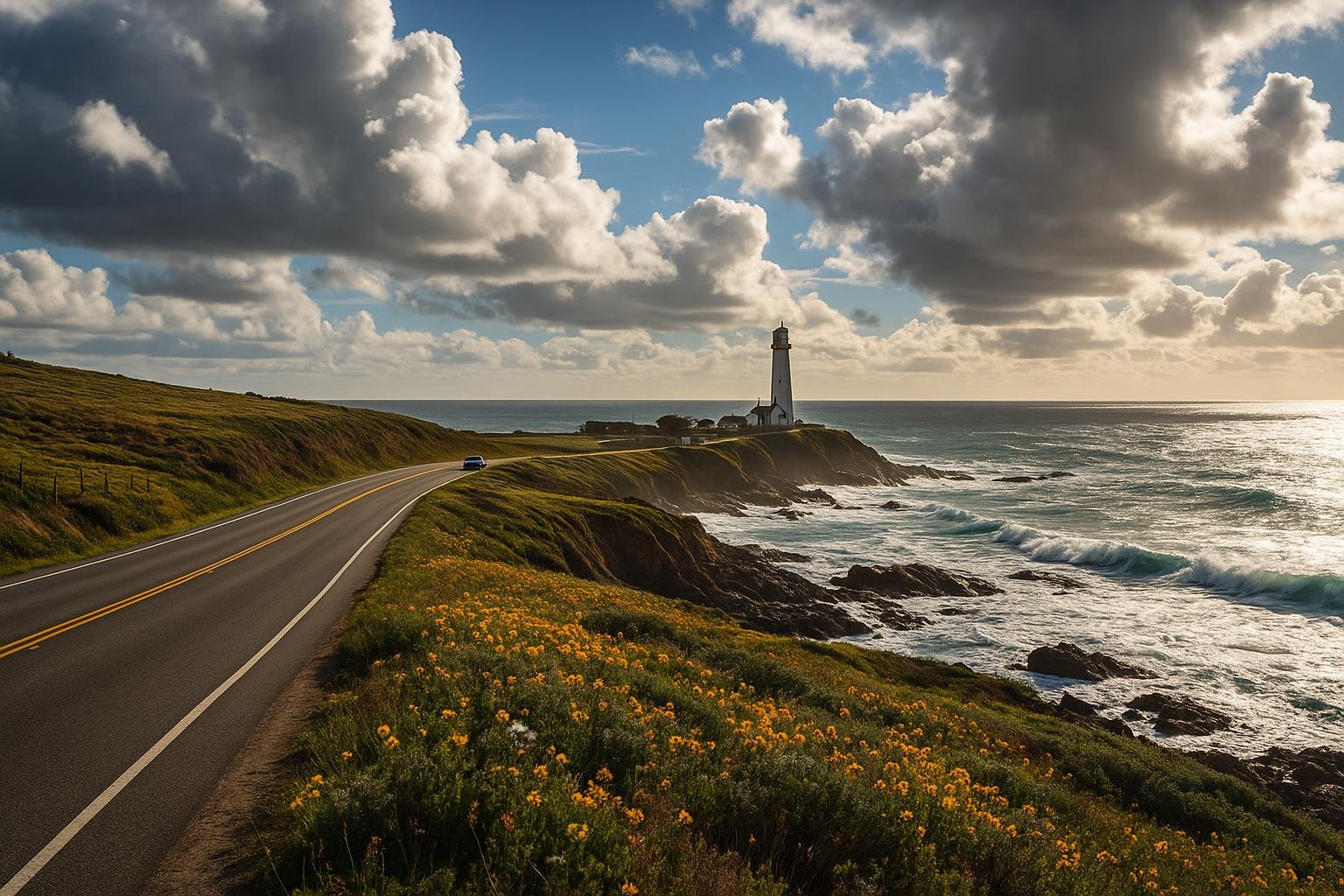
South of the city the road belongs to the fog, the pumpkin fields and the tallest lighthouse on the coast.
Highway 1 south through Pacifica, where the Devil's Slide Trail is a twenty-minute clifftop walk with no traffic to dodge, and the surf at Pillar Point and Mavericks — one of the most feared big-wave breaks in the world — comes into view before the road drops into Half Moon Bay itself. Lunch on the harbor, a walk down Main Street, and a choice of how far south to push: Pigeon Point Lighthouse and Pescadero for artichoke soup at Duarte's Tavern and goat cheese at Harley Farms, or the elephant seals at Año Nuevo in winter. Turn around by mid-afternoon for a last dinner in the city, or, if this day is the start of a longer coastal drive, keep going south.
Insider Notes
- The Devil's Slide Trail is paved and stroller-friendly, built on the old highway bed after the road was rerouted through a tunnel.
- Duarte's Tavern in Pescadero has been open since 1894 and the artichoke soup is the reason; arrive for a late lunch to avoid the weekend line.
- Año Nuevo requires a guided walk during the December-to-March pupping season, booked well ahead — outside that window it is a self-guided walk.
Where to Eat
- Lunch — Sam's Chowder House at Half Moon Bay harbor for the lobster roll on the deck; it is the reason people drive here from the city.
- Alternative — Duarte's Tavern in Pescadero, twenty minutes further south, for the artichoke soup in an 1894 saloon.
- Dinner — Kokkari Estiatorio near Union Square for Greek cooking in a room built like a farmhouse, back in the city.
- Sundowner — a last drink on the Embarcadero, watching the ferries come in one more time before the trip moves on.
Tickets & Costs
| Devil's Slide Trail | Free |
| Pigeon Point Lighthouse grounds | Free |
| Año Nuevo guided walk, in season, per person | $10 |
Keep going south?
If this coast day is the start of a longer drive rather than an out-and-back, do not turn around at Half Moon Bay. Carry on past Pigeon Point into Santa Cruz and around Monterey Bay to Carmel, and the trip becomes the eleven-day Highway 1 journey — Big Sur, the Santa Ynez Valley, Santa Monica and San Diego, all the way down the coast.
Before You Go
Book these before you leave home.
Three things on this itinerary sell out days to weeks ahead in season, and there is no walk-up alternative for any of them. Everything else in these four days can be decided on the morning.
What sells out
- Alcatraz — sixty to ninety days ahead, direct from Alcatraz City Cruises, for Day 1
- Muir Woods parking or the shuttle — required for any Marin day, and gone on weekends
- A Mission dinner reservation — a week out; the good rooms on Valencia and 18th are small
- Plus the tables worth planning around: Che Fico on Divisadero, booked the day its calendar opens, and Watershed in Mill Valley for the Day 3 brunch deck. And the rental car for Days 3 and 4, reserved early if you want an automatic collected downtown rather than at the airport.
Every ticket, gathered · per person unless noted
| The city · Day 1 | |
| Rideshare, SFO to downtown | $45–70 |
| Alcatraz Day Tour / Night Tour | $45 / $56 |
| Cable car, single ride | $8 |
| de Young Museum (tower free without ticket) | $20 |
| Japanese Tea Garden | $15 |
| Lands End trail and Sutro Baths | Free |
| The Golden Gate and the Mission · Day 2 | |
| Bike rental, full day | $40–55 |
| Golden Gate Ferry, Sausalito to the city, bikes free | $14–15 |
| Presidio, Alamo Square, Palace of Fine Arts | Free |
| Marin · Day 3 | |
| Muir Woods entry and parking/shuttle reservation | $15–20 |
| Mount Tamalpais State Park, day use (per vehicle) | Free–$8 |
| Golden Gate Bridge toll, southbound (per car) | $10 |
| The coast · Day 4 | |
| Devil's Slide Trail | Free |
| Pigeon Point Lighthouse grounds | Free |
| Año Nuevo guided walk, in season | $10 |
Getting here and getting around
- Fly into SFO and take a rideshare or taxi downtown — thirty-five to forty-five minutes, and cheaper than most people expect.
- You do not need a car for the first two days. Overnight parking runs $60 to $80 a night downtown, and every place on Days 1 and 2 is reachable by bike, cable car, ferry or a short ride.
- Days 3 and 4 do need one. A one-day rental for Marin, or a car collected downtown on the morning of Day 3 and kept through the coast day, is the cheapest way to do it — still less than four nights of hotel parking.
- The Golden Gate Bridge toll is electronic and southbound only. No booths. Rental companies pass it on with a daily administrative fee; pay it yourself at goldengate.org within 48 hours, using the licence plate, and the fee disappears.
- If you are continuing on to wine country or the coast afterward, collect the rental car on your way out of the city rather than on arrival.
A note on neighborhoods
- San Francisco's street issues are real but concentrated — the Tenderloin, Civic Center and Mid-Market, roughly the blocks west of Mason Street and along Market between 5th and 10th. Every hotel in this itinerary sits well clear of them, and nothing in these four days routes you through them. Walk east and north from Union Square, not west.
Money and tipping
- Tipping is not optional. Eighteen to twenty percent of the pre-tax bill in restaurants, twenty for good service; a dollar or two per drink at the bar; $5 to $10 a day for housekeeping; $5 for a valet.
- Sales tax is added at the register, not shown on the shelf. Menu prices are pre-tax and pre-tip; a $100 dinner is $130 out the door.
- Hotel taxes and fees are the real sting. San Francisco adds over 16 percent, and some properties add an amenity or destination fee on top. Every rate in this itinerary is quoted before these; budget for them.
- Cards are accepted everywhere in this city, including at farmers markets and food trucks — the Chinatown takeout counters are the exception, and some of them are still cash only. Decline dynamic currency conversion if a card terminal offers to charge you in your home currency; the rate is always worse.
September and October — the seasonal reality
- These are the finest weeks of the year here — the fog retreats, the air is clear, the hills are gold — and they are also fire season. Most years nothing happens; some years the air fills with smoke for a week and a park or a coast road closes. Travel insurance that covers cancellation for wildfire is worth the premium.
- Summer, by contrast, is fog: "June gloom" sits over the coast most mornings and often all day, and the city can go a week in July without seeing the sun. It burns off inland — Marin's valleys and Mount Tamalpais will be warmer — but the beach days can disappoint. Spring, from mid-April to May, is the second-best window: green hills, wildflowers, whales, and prices well below September.
- Restaurants here open at five for dinner, and Sunday brunch is a competitive sport. Book.
Practical odds and ends
- Layers decide how much you enjoy this trip. A San Francisco evening is 55°F in August and the fog arrives around four. Pack for both ends of the day, every day, and carry a jacket.
- The sun is stronger than it feels. The marine layer diffuses it and people burn through fog. Sunscreen and a hat on the bike day, at Lands End, and on the coast.
- Tap water is excellent everywhere here. Carry a bottle; the parks and trailheads have refill stations, and a bottle of water at a beach concession is $4.
- Car break-ins are the practical crime risk in the city and at coastal trailheads. Never leave anything visible in a parked car — not a jacket, not a charging cable. This is one more reason the car only appears for the two days you actually drive.
- Reservations run on apps. Resy, OpenTable and Tock hold most of the tables in this itinerary; set alerts for the hard ones. Walk-in culture survives only at the taco counters and the oyster bars.
- Get an eSIM before you leave if you are arriving from abroad; it activates on landing, and you will want data for the reservations, the tide tables and the road status.
- The emergency number is 911 throughout the United States. Travel medical coverage is essential — a night in an American hospital without it runs into five figures.